
Your Essential Website Planning Guide - Defining Purpose & Audience
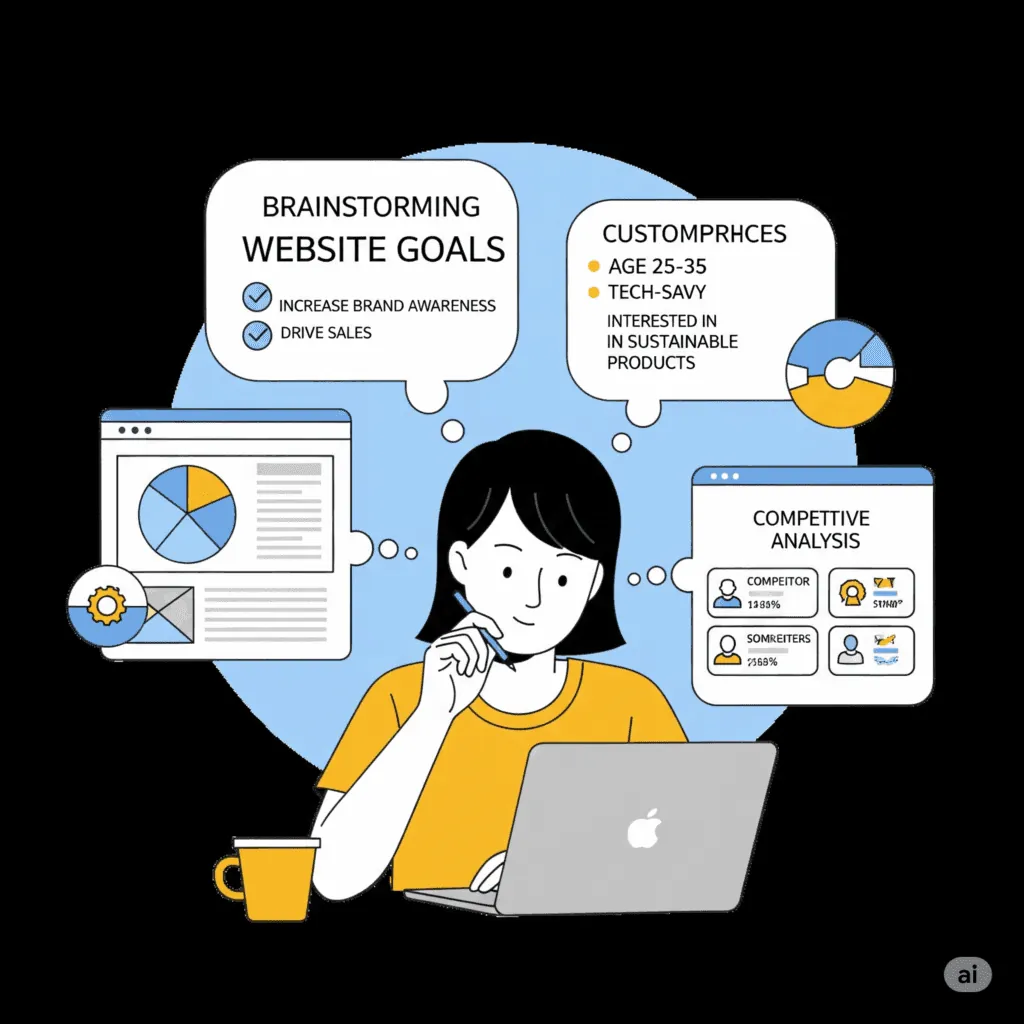
Welcome to the very first step in creating your amazing new website with JWD Website Design! We know that starting a web project can feel like a big undertaking, especially if you’re not a tech expert. That’s why we’ve created this Website Planning Guide series, designed to walk you through each crucial stage in a clear, simple way. This detailed Website Planning Guide is designed specifically for you.
This first part is all about the “why” and the “who” behind your website. Before we dive into design or features, we need to understand your business’s core purpose and who you want to reach. Think of this as laying the foundation for a strong, effective online presence. The more clarity we have here, the better we can tailor your website to achieve your specific goals. This comprehensive Website Planning Guide will set you up for success, right from the start.
Understanding the “Why”: Your Business Vision & Website Goals
Every successful website starts with a clear purpose. Without knowing why you need a website, it’s like building a house without a blueprint - it might look nice, but it won’t serve its function effectively. This section of our Website Planning Guide helps you articulate that purpose.
Q1: What is Your Business’s Core Mission and Identity?
This question goes beyond just what you sell. It’s about your business’s soul. As part of your Website Planning Guide, understanding this deep core is fundamental.
- What problem do you solve for your customers, or what unique value do you provide? Think about the pain points your clients experience before they find you, and how your product or service alleviates that. For example, a plumbing service solves the problem of leaky pipes; a financial advisor solves the problem of financial uncertainty.
- What makes your business truly unique? This is often called your Unique Selling Proposition (USP). Is it your exceptional customer service? A proprietary method? A specific niche you serve? Your commitment to sustainability? Your local expertise in Cape Town? This is what sets you apart from the competition and should be a central theme in your Website Planning Guide.
- What products or services do you offer in detail? Don’t just list them; briefly describe what each one entails. For instance, if you offer “Web Design,” specify if that includes e-commerce, custom development, or just basic informational sites. This helps us understand the scope and how to structure your service or product pages effectively within your overall Website Planning Guide. If you are still weighing up scope, our range of website design packages makes it easy to match the build to your needs, from a simple 1-3 page website through to a full e-commerce website.
Example: If you’re a small bakery in Cape Town, your USP might be “hand-crafted sourdough breads made with locally sourced organic ingredients,” distinguishing you from a mass-produced bakery.
Tip: Imagine explaining each service to someone who knows nothing about your industry. What are the key features and, more importantly, the benefits to the customer?
What is your brand personality? If your brand were a person, how would you describe it? Are you:
- Professional & Authoritative: (e.g., a law firm, a financial institution)
- Friendly & Approachable: (e.g., a local coffee shop, a family-run business)
- Innovative & Cutting-Edge: (e.g., a tech startup, a design agency)
- Luxurious & Exclusive: (e.g., a high-end boutique, a bespoke travel agency)
- Playful & Creative: (e.g., a children’s toy store, a graphic design studio)
This personality will influence everything from the colours and fonts we use to the tone of voice in your website copy. It’s a crucial part of your Website Planning Guide.
Q2: What are the Main Goals for Your New Website?
This is where we define what success looks like for your online presence. Be as specific as possible. This is a core element of your Website Planning Guide.
What is the primary purpose of this website? (You can choose more than one, but please rank your top 3 in order of importance). This helps us prioritise features and design elements.
- Lead Generation: Do you want visitors to fill out a contact form, call you directly, or sign up for a consultation?
- Online Sales (E-commerce): Is the main goal to sell products or services directly from your website?
- Information Hub: Is your site primarily for educating visitors, providing resources, or showcasing your expertise (e.g., a blog, a knowledge base)?
- Brand Awareness/Visibility: Is the goal simply to establish a professional online presence and make your business discoverable?
- Portfolio/Showcase: Are you an artist, photographer, or designer looking to display your work?
- Customer Support: Do you want to provide FAQs, troubleshooting guides, or a chat function to assist existing clients?
- Community Building: Are you looking to create a forum, a membership area, or a platform for user interaction?
What are your specific, measurable goals for the website? This is where we get into SMART goals (Specific, Measurable, Achievable, Relevant, Time-bound). Instead of “get more customers,” think:
- “Increase online inquiries by 20% within the first 6 months of launch.”
- “Generate R50,000 in online sales per month within the first year.”
- “Reduce customer support calls by 15% by providing comprehensive FAQs online.”
- “Attract 5,000 unique visitors per month within 12 months.”
- “Achieve 100 new newsletter sign-ups per month.”
Why SMART goals? They give us concrete targets to work towards and allow us to measure the website’s performance after launch. For more detail on setting effective goals, check out this simple guide to SMART goals. This is a key component of any effective Website Planning Guide.
Q3: Who is Your Ideal Customer or Website Visitor? (The “Who”)
Understanding your audience is perhaps the single most important element in this Website Planning Guide. Your website needs to speak directly to them, address their needs, and guide them towards solutions.
Imagine your ideal customer. Give them a name, an age, and a background. This is called creating a customer persona.
- Demographics: What is their age range, gender, location (e.g., specific city like Cape Town, region, or even neighbourhood if you’re a local business), occupation, income level, education?
- Psychographics: What are their interests, hobbies, values, and lifestyle? What are their attitudes towards your industry or products?
- Pain Points/Challenges: What problems do they face that your business can solve? What frustrations do they have with current solutions? What questions are they searching for answers to online?
- Motivations: What drives them to seek out a business like yours? What are their aspirations? What benefits are they truly looking for?
Example: If you sell ergonomic office chairs, a pain point might be “back pain from sitting all day,” and a question might be “best office chair for posture.”
How do they currently find information or businesses like yours? Do they use Google search, social media (Facebook, Instagram, LinkedIn), referrals, online directories, or specific industry forums? Knowing this helps us understand their online behaviour and where to focus our marketing efforts. If most of your audience is searching on Google, investing in SEO services early on can be the difference between being found and being invisible. This insight is critical for your Website Planning Guide.
Why is this so crucial for your website?
- Content Relevance: If we know their pain points, we can create content that directly addresses them, making your website a valuable resource.
- Design Appeal: Their demographics and psychographics influence the visual style, colours, and imagery that will resonate with them.
- User Experience (UX): Understanding their online habits helps us design intuitive navigation and calls to action that make sense to them.
- Language & Tone: The way you speak to a young, tech-savvy audience is different from how you’d address a more mature, corporate audience. Your website’s language should reflect this.
- Conversion: Ultimately, a website built for the right audience is more likely to convert visitors into leads or sales. This targeted approach is a cornerstone of our Website Planning Guide.
Q4: Who are Your Competitors, and How Do You Stand Out?
Understanding your competitive landscape is vital. It helps us identify opportunities to differentiate your business and ensure your website shines. This part of your Website Planning Guide helps us position you uniquely.
Please list 2-3 of your main competitors’ websites. These should be businesses that offer similar products or services to your target audience.
What do you like about their websites? Be specific. Is it their:
- Ease of Navigation: Is it simple to find information?
- Clear Pricing: Do they make it easy to understand costs?
- Compelling Calls to Action: Do their buttons make you want to click?
- Specific Features: Do they have a unique tool, calculator, or interactive element you admire?
- Visual Design: Do you like their colour scheme, imagery, or overall aesthetic?
- Content Quality: Is their blog informative, or are their product descriptions compelling?
What do you dislike or what could they improve on their websites? This is equally important for your Website Planning Guide.
- Is their site slow to load?
- Is the design outdated or cluttered?
- Are their menus confusing or hard to find?
- Is there a lack of essential information?
- Do they have broken links or poor mobile responsiveness?
Identifying weaknesses in competitor sites gives us opportunities to make your site superior. If a rival’s site has slipped down the rankings or loads slowly, a focused SEO Rescue and reliable website maintenance plan are exactly the kind of advantages that help you overtake them.
How will your new website differentiate you from these competitors? Based on your USP (from Q1) and your analysis of competitors, what unique aspects will your website highlight to make your business the preferred choice?
Example: If competitors have slow, cluttered sites, your differentiation could be a fast, clean, and user-friendly experience. If their services are vague, yours could be exceptionally clear and detailed. This strategic thinking is a core part of your Website Planning Guide.
Why This Initial Planning is Non-Negotiable
You might be thinking, “Can’t we just jump straight to designing?” While we’re excited to get creative, this initial planning phase is absolutely non-negotiable for a successful website build. Here’s why this Website Planning Guide emphasizes early strategy:
- Saves Time & Money: A clear plan upfront prevents costly revisions and reworks later in the project. It ensures we build exactly what you need from the start, saving both time and budget.
- Ensures Relevance: Without understanding your audience and goals, we risk building a website that looks good but doesn’t connect with your ideal customers or achieve your business objectives. This Website Planning Guide ensures everything is aligned with your core mission.
- Better ROI: A strategically planned website is an investment that pays off. It’s designed to attract the right traffic, convert visitors, and ultimately contribute to your business growth.
- Smooth Development Process: When we have all this information, our JWD Website Design team can work efficiently, knowing exactly what needs to be done. It streamlines the entire Website Planning Guide process, leading to a faster and more satisfying launch.
Next Steps for Part 1
Once you have thoroughly considered and answered the questions in this Website Planning Guide for Part 1, please compile your responses. You can put them into a Word document or a Google Doc.
The more detail and thought you put into these answers, the more effectively and efficiently we can proceed with your website project. This is the foundation upon which your entire online presence will be built, and your input here is invaluable. For any questions, remember you can always contact JWD Website Design.
Once you’re ready, please notify your JWD Website Design contact. We will review your responses, clarify any points, and then guide you to Part 2 of our series, where we’ll start discussing the look, feel, and specific features of your website.
FAQs for Part 1 of Your Website Planning Guide
Q: Do I need to have all my business details and goals perfectly defined before I contact JWD? A: No, but having a good initial understanding is immensely helpful. This Website Planning Guide is designed to help you think through these points. We can always refine them together during a strategy session, but the more groundwork you do, the faster we can move forward with your project.
Q: What if I’m not sure who my exact target audience is? A: That’s common, especially for new businesses or those exploring new markets. Do your best to describe who you think your ideal customer is. We can then work with you to conduct basic market research or brainstorming exercises to help define your audience more clearly, which is a key part of this Website Planning Guide.
Q: Why do you need to know about my competitors? Isn’t my website about my business? A: Absolutely, your website is about your business! However, understanding your competitors helps us ensure your website stands out. By seeing what works and what doesn’t for them, we can identify opportunities to make your site more appealing, user-friendly, and effective in attracting your shared target audience. It’s a strategic move in any good Website Planning Guide.
Q: How long should my answers be for each question? A: There’s no strict word count, but aim for clarity and completeness. For example, for “What products or services do you offer?”, a simple list isn’t enough; a brief description and key benefits for each are much more useful. For your “ideal customer,” a few bullet points are a start, but a short paragraph describing their typical day or challenges would be even better.
Q: What if I change my mind about my goals or audience later? A: While this Website Planning Guide aims to solidify your vision, we understand that businesses evolve. Minor adjustments are usually manageable. However, significant changes to core goals or target audiences mid-project can lead to delays and additional costs, as they might require substantial re-design or re-development. That’s why this initial clarity is so important for your Website Planning Guide.
Get a Website That Keeps Working for You
JWD Website Design builds and maintains WordPress websites for South African businesses. From initial design to ongoing care, we make sure your website stays fast, secure, and effective. When you have worked through this Website Planning Guide, the easiest next step is to request a free quote so we can turn your answers into a clear proposal, or browse our website design packages to see exactly what is included. We are ready when you are.
Frequently Asked Questions
Is this website planning guide the only part, or is there more?
This is Part 1, focused on the why and who behind your website: your business purpose, goals, ideal customer, and competitors. Once you have worked through these questions and notified your JWD contact, the team reviews your answers and guides you to Part 2, which covers the look, feel, and specific features of your website.
What format should I use to submit my planning answers to JWD?
Once you have thoughtfully answered the Part 1 questions, compile your responses into a Word document or a Google Doc. The more detail you include, the more effectively and efficiently the JWD team can proceed. When you are ready, notify your JWD Website Design contact, and the team will review your answers and clarify any points before moving forward.
What does it cost to get started once my planning is done?
The guide does not tie a single price to planning, because cost depends on the build you need. JWD packages start at R2500 for a 1-3 page website, R3500 for 3-5 pages, R6000 for a business website, and R6500 for an e-commerce website. The simplest next step is to request a free quote so your answers become a clear proposal.
What is a SMART goal and why does JWD ask for them?
SMART goals are Specific, Measurable, Achievable, Relevant, and Time-bound, for example increasing online inquiries by 20% within six months rather than vague aims like get more customers. JWD asks for them because they give concrete targets to work towards and let the team measure the website’s performance after launch.
What kind of website goals can JWD help me prioritise?
The guide lists several primary purposes you can rank: lead generation, online sales (e-commerce), an information hub, brand awareness and visibility, a portfolio or showcase, customer support such as FAQs, and community building. You can choose more than one, and ranking your top three helps JWD prioritise the right features and design elements for your site.