Eco-Match: A Website Case Study
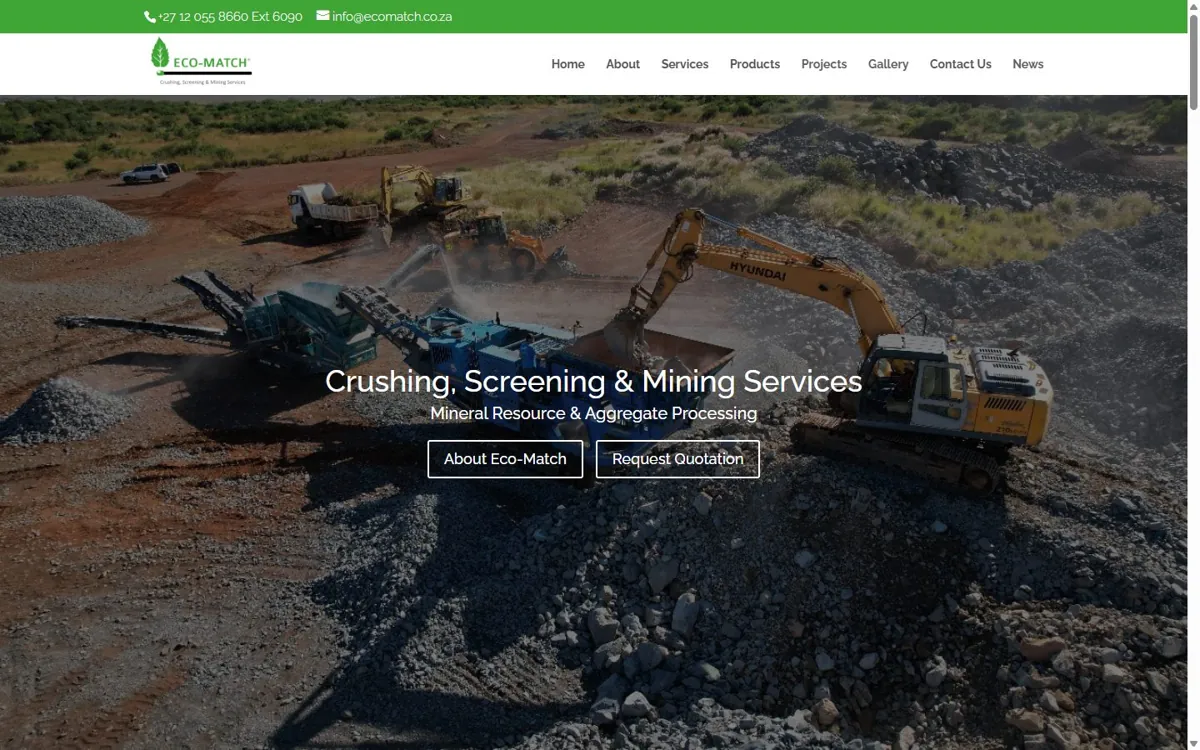
Eco-Match is a mobile crushing and screening service provider based in Menlyn, Gauteng, serving the mining, industrial, and construction sectors. The company is a B-BBEE Level 4 Contributor, with its company registration number stated directly on its site, a detail that matters for a business regularly working through formal procurement processes.
About Eco-Match
The service scope covers mobile crushing and screening at single, two-stage, and multi-stage levels, rental of jaw, impact, cone, and VSI crushers and scalpers, screening equipment rental, controlled drilling and blasting, loading and hauling, quality control and sample testing, and recycled concrete aggregate processing. The business also supplies aggregate products directly, including G Aggregates, Concrete Stone, Road Stone, Ballast Rock, Rip Rap, and Gabion Stone.
That combination, equipment services, contracted operational work, and direct product supply, means Eco-Match is bidding for and fulfilling work across several different procurement categories at once.
What the website needed to do
Mining and construction procurement runs on formal specification matching. The site needed to lay out Eco-Match’s actual service and equipment categories clearly enough that a procurement officer or site manager could quickly confirm capability against a specific project requirement, whether that is contracted crushing services, equipment rental, or a direct aggregate product order.
The B-BBEE rating and formal company registration needed genuine visibility too, since both are frequently hard requirements, not soft preferences, in South African mining and construction sector procurement and tender processes.
Why this matters for mining and construction supply and services businesses generally
For any business supplying equipment, services, or materials into mining and construction procurement processes, formal compliance credentials, BEE rating, registration numbers, relevant certifications, function as gatekeeping information. A buyer working through a structured procurement process needs this information readily available and clearly stated, not something they have to specifically request.
Presenting equipment rental, contracted services, and direct product supply as distinct, clearly labelled offerings also helps a buyer quickly identify which procurement category their specific need actually falls under.
The result
Eco-Match’s site is live now at ecomatch.co.za, built to present the company’s crushing and screening services, equipment rental, and aggregate product supply clearly, with its B-BBEE rating and registration prominently available. It is one of the businesses featured on our portfolio.
Considering something similar?
Mining and construction supply and services businesses vary in cost depending on how many services and equipment categories need presenting. Our Business Website package is the usual starting point. Request a quote and we can confirm exact pricing for your business.
Frequently Asked Questions
How much does a website for a mining or construction supply business cost?
It depends on how many services, equipment categories, and products need presenting. Our Business Website package is the usual starting point, and we confirm exact pricing once we understand your business.
Why does BEE rating need to be stated clearly on an industrial website?
Because it frequently functions as a hard requirement, not a soft preference, in South African mining and construction procurement and tender processes. Making it easy to find removes friction at the earliest stage of a formal buyer evaluation.
How should a business offering both services and direct products organise its website?
By presenting each category (contracted services, equipment rental, direct product supply, for example) as its own clear offering, since a procurement buyer typically needs to match a specific requirement to exactly one of these categories.
Does company registration information need to appear on the website?
It helps for businesses regularly working through formal procurement processes, since buyers conducting due diligence often want to verify registration details before proceeding, and having it readily available removes an unnecessary step.
Who is the buyer for mobile crushing and screening services?
Typically a procurement officer, site manager, or project engineer working within a mining, construction, or industrial project, evaluating suppliers against a formal specification or tender requirement rather than browsing casually.
How long does a website project for a mining or construction supply business take?
We confirm the timeline once the scope is agreed. It depends on scope, since presenting service tiers, equipment rental options, and product ranges accurately, alongside compliance credentials, takes real coordination with the client.
Should aggregate and material products be listed with specifications like size or grade?
Where practical, yes. A buyer specifying materials for a construction or civil project often needs to confirm exact specifications before ordering, and including this detail directly on the site reduces unnecessary back and forth before a purchase can proceed.
Does mobile equipment rental need separate pricing from contracted crushing services?
Generally yes, since they are different commercial arrangements. Rental is typically a fixed cost for equipment access, while contracted crushing services usually involve a scope of work and outcome, and conflating the two pricing models can create confusion for a buyer trying to budget accurately.
Should recycled materials, like recycled concrete aggregate, be marketed differently to primary aggregate?
Yes, particularly toward buyers with sustainability or environmental targets on their projects. Highlighting recycled aggregate as its own distinct product line, rather than folding it into a general aggregate offering, helps it reach the specific buyers actively looking for a more sustainable material option.