Dino Miranda: A Musician's Website Built Like a Record
Dino Miranda is a Mozambican singer, guitarist, composer, arranger and producer whose music sits where Marrabenta meets Afro-pop, jazz and world fusion. On 26 October 2026 dinomiranda.com moved off WordPress and onto a new site we built for him, with three upgrades in one project: a new look and feel, a new platform underneath, and a full search setup.
This case study covers what the old site was missing, how the new design works, and what Dino and the people who book him now get from it.
About Dino Miranda
Dino studied at the FUBA School of Music in Johannesburg and then jazz at the University of Cape Town. His debut album, Moya Wa Kaya (2008), won Best Jazz at the Mozambique Music Awards and Best New Artist at Ngoma Moçambique in 2009. In 2016 his song “Marrabenta” won the World Music category of the International Songwriting Competition in the USA. His second album, Xiluva, followed in 2018.
He has performed across Mozambique, South Africa, Zimbabwe, Malaysia, Germany and Sweden, at festivals such as the Cape Town International Jazz Festival, HIFA in Harare and the Afrika-Festival in Stuttgart. His label is Miramundo Produções.
That gives the website three audiences: fans who want to listen and watch, promoters and event organisers who want to book him, and journalists and festivals who need a press kit.
Where it started
The old site ran on WordPress with the Divi page builder. It held 7 pages and 55 posts, and most of those posts were single videos or short updates. The music, videos, press and photos were all there, but scattered across posts rather than organised for the people who use an artist’s website, and there was no proper way to send a booking request or download press material.
All of the content on the new site, including every photo and video, came from the old one or from Dino himself. Nothing was invented.
The design: a record, front to back
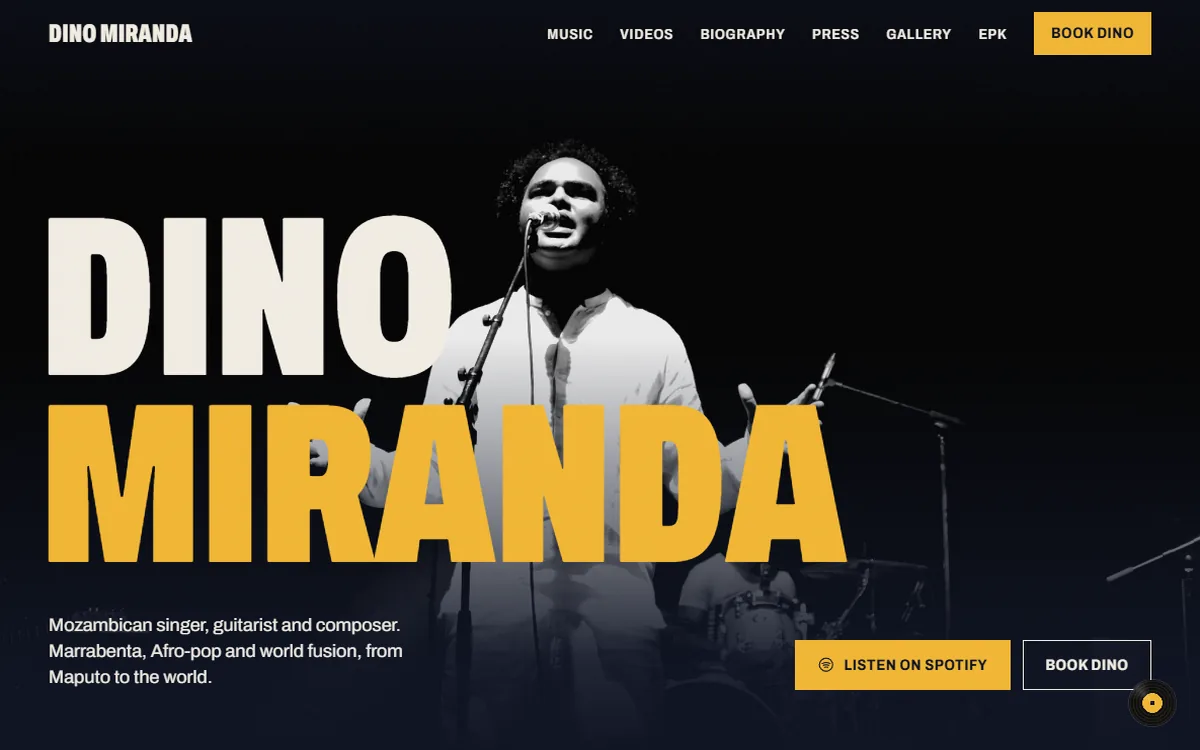
The new site is designed like a vinyl record and its sleeve:
- The home page opens like a front cover, with Dino’s name set large over a black and white stage photo.
- The home page sections are marked Side A and Side B, like the two sides of a record.
- The biography page is called Liner notes.
- The footer reads like the back-cover credits, including his label.
The type is a single family, Archivo, used narrow, heavy and uppercase for headings and at normal width for reading. Photos are black and white and turn to colour when you hover over them. Corners are sharp throughout.
At Dino’s request the colours are midnight navy and saffron gold. While the design was being reviewed, a colour switch on the page itself let Dino and his team compare three colour schemes on the real site, rather than in mock-ups, before settling on one.
What we built
Music and videos that load only when asked
Every release in the discography links to Spotify and Apple Music. Videos use a click-to-play player: nothing loads from YouTube until a visitor presses play, which keeps the pages fast and means nothing is fetched from YouTube just for opening a page.
A biography in English and Portuguese
The Liner notes page carries Dino’s full biography in English and Portuguese, with a switch at the top to change language. For an artist with fans and promoters in both Mozambique and the English-speaking world, both versions matter.
A press kit page
The EPK (electronic press kit) page is built for journalists, festivals and promoters. It brings together a short biography, career highlights, music, a stage plot, press photos and cover art, and everything can be downloaded: the whole press kit as one file, a PDF version, eight high-resolution press photos and the cover art for five releases.
Booking requests with everything a promoter needs
The Book Dino page is a structured booking request rather than a blank contact form. It asks for the event type, date, city and country, venue, expected audience, set length, performance format (from full band to solo acoustic) and an optional budget. Each request gets a reference number, the person booking receives a copy by email, and they see a summary they can save or print. Every request is also kept on record, even if an email were ever to fail.
An admin Dino runs himself
Dino edits the site from his own admin area, with a section for every part of it: the home page banner, discography, featured new release, videos, gallery, biography, press, press kit, awards and festivals, collaborations, live dates and contact details. Booking requests and newsletter sign-ups are listed there too. Every save keeps a version history, and an “earlier versions” screen restores a previous one if something goes wrong. The site’s content is also backed up automatically every night, and Dino has a written guide, with screenshots, showing how to run it all.
Search, AI search and analytics
Moving platforms did not mean starting from zero in search:
- Old web addresses redirect. The old WordPress pages and posts were mapped to their new homes with 61 permanent redirects, so links already shared on social media, in press articles or in search results still land in the right place.
- Structured data. The site describes Dino as a person in structured data, which helps search engines and AI tools understand who he is.
- Search Console and Bing. The site is verified in Google Search Console and Bing Webmaster Tools, with the sitemap submitted to both, and old WordPress sitemaps were removed.
- Analytics with consent. Google Analytics 4 is set up with a consent banner and Google’s Consent Mode, and tracks the actions that matter for an artist: listens, video plays, social clicks, booking requests and newsletter sign-ups.
- Readable by AI. The site publishes an llms.txt file and an AI catalogue, which give AI assistants a clean summary of who Dino is and what is on the site.
We ran Google PageSpeed Insights on the live home page on 29 October 2026:
| Performance | Accessibility | Best Practices | SEO | |
|---|---|---|---|---|
| Mobile | 90 | 97 | 100 | 100 |
| Desktop | 98 | 97 | 100 | 100 |
Both runs passed all four of PageSpeed’s Agentic Browsing checks, which look at whether AI assistants can read and use the page. These are lab scores from a single run; scores move a few points between runs.
What Dino gets out of it
- A site that looks like his music. A design built around the record, not a template.
- One place for promoters. Bookings arrive with the details needed to reply with availability and a quote.
- A press kit that is always current. Journalists and festivals download what they need without having to ask.
- Fans in two languages. The biography reads in English and Portuguese.
- Control. Dino updates his own site, with version history behind every change.
This is another example of a site moved off WordPress onto a custom build. For more of our work for clients outside South Africa, see our article on custom web development for global businesses, and for how a custom site with its own admin compares to WordPress, read static website vs WordPress vs custom CMS. Everything else is on our portfolio.
Considering something similar?
If you are an artist, band or performer, your website has to work for fans, promoters and press at the same time. The cost depends on the number of pages, what has to move across from your current site and the features you need, such as a press kit, booking requests or a second language. Our custom CMS website packages are the starting point for a site you can edit yourself, and anything beyond them is quoted on scope. Request a quote and we will tell you honestly what you need.
Frequently Asked Questions
What should a musician’s website include?
At minimum: music with links to the streaming services, videos, a biography, photos, upcoming dates and a way to book. Dino Miranda’s site adds a downloadable press kit, a structured booking request form, a newsletter sign-up and a biography in two languages.
What is an EPK?
An EPK, or electronic press kit, is the set of material journalists, festivals and promoters need to write about or book an artist: a short biography, highlights, music, press photos, cover art and, for live bookings, a stage plot. On Dino Miranda’s site it is a page of its own, and the whole kit can be downloaded as one file.
Can a musician update their own website?
Yes. Dino Miranda edits his site from his own admin area, including releases, videos, photos and press, and every save keeps a version history so earlier versions can be restored.
Will moving off WordPress break old links?
Not if it is planned. When dinomiranda.com moved off WordPress, the old pages and posts were mapped to their new homes with 61 permanent redirects, so links already shared online still work.
Do embedded YouTube videos slow a website down?
They can, because each standard embed loads YouTube’s player as the page opens. Dino Miranda’s site loads a video only when a visitor presses play, so the page stays fast and nothing loads from YouTube until it is needed.
Is Dino Miranda’s website still on WordPress?
No. Since 26 October 2026 dinomiranda.com runs on a custom site built by JWD, with an admin area Dino uses to edit it himself.