To The Point International: A Defence Systems Website Case Study
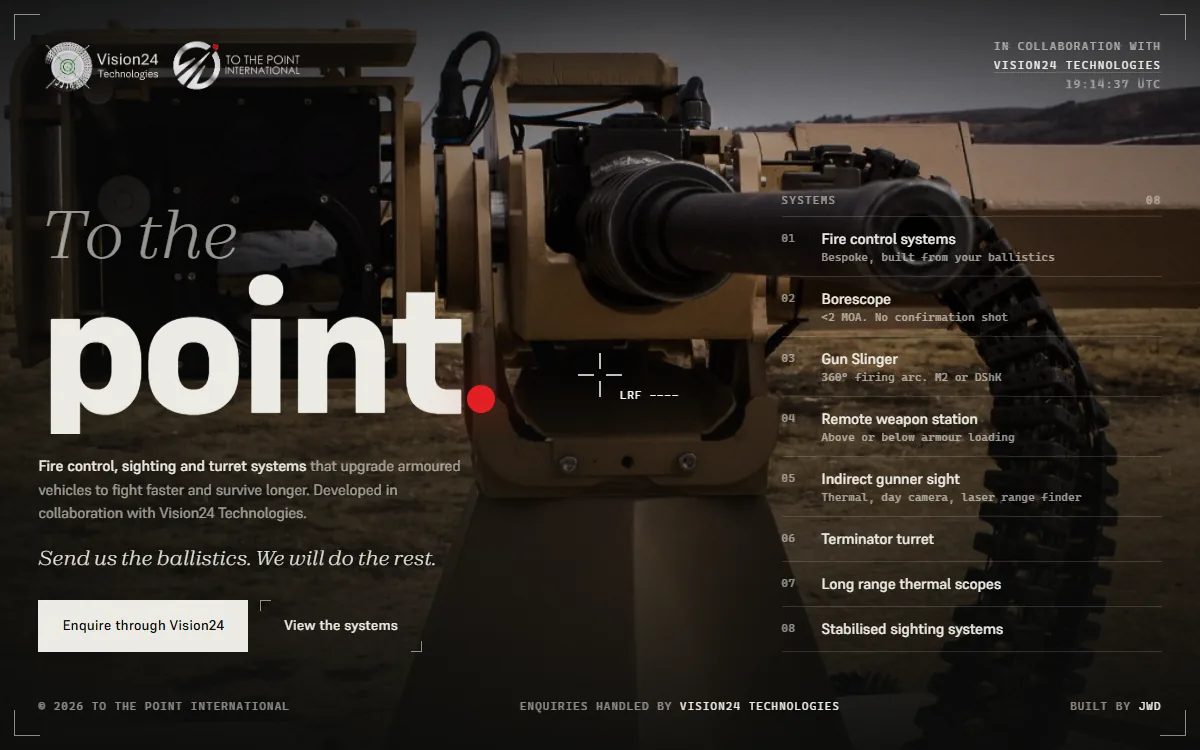
To The Point International upgrades armoured vehicles with fire control, sighting and turret systems, developed in collaboration with its sister company, Vision24 Technologies. Its systems range from bespoke fire control built from a customer’s own ballistics to remote weapon stations, stabilised sighting systems and long range thermal scopes. The site went live at tothepointint.com on 1 October 2026.
This was a splash page, not a full website. Its job is narrow and specific: introduce To The Point International, make the connection with Vision24 unmistakable, and send every serious enquiry to the right place.
The brief: one page, one destination
Three rules from the client shaped everything.
Every enquiry goes to Vision24. Product information and enquiries are handled by Vision24 Technologies, so every product link and every call to action on the page points to Vision24’s own product and contact pages. The only other outbound link is the small “Built by JWD” credit in the footer.
Both brands, side by side. The Vision24 and To The Point International logos appear together, with no background plate behind them, keeping the original red dot and green crosshair of each mark.
No email address on the page. The company has a main email address, and it deliberately does not appear. Enquiries go through Vision24’s contact page instead, which keeps them in one place.
A brief like that could easily produce a forgettable page with two logos and a button. The products deserved better than that, and a buyer for this kind of equipment forms an impression in seconds.
The idea: the view through a gunner’s sight
The page is built as the view through a gunner’s sight. When it loads, you are looking through the optics:
- Boot screen. While the page loads, the preload is shown as a thermal camera core cooling down, from 293 K towards its operating temperature. Loading time becomes part of the story rather than a spinner.
- Thermal search. A white-hot thermal image of a vehicle fitted with a fire control system appears. The sight slews across it, steps through its zoom and locks on, and the laser range finder reports a distance.
- To the point. The view collapses to a single red point. That point travels to the full stop at the end of the headline “To the point.” and the daylight image opens out from it.
- Idle. Once the sequence ends, the cursor becomes a reticle. Click anywhere and the sight lases, with a range readout and a red ping.
The heads-up display stays honest to the idea. The bottom corners carry the search, track and lock status and the range readout, the top right shows the time in UTC, and the eight systems are listed down the right-hand side like an equipment panel, each one linking straight to its entry on Vision24’s product page.
The red point is the thread through the whole thing. It is the dot in the To The Point International logo, the laser spot on the target and the full stop in the headline, so the brand name and the product are the same idea on screen.
Real equipment, not stock imagery
The thermal phase uses Vision24’s own photograph of a vehicle fitted with a fire control system, and the daylight backdrop is Vision24’s own photograph of a remote weapon station. Nothing on the page is a stock photo of somebody else’s hardware. For a company selling equipment to people who know exactly what they are looking at, that matters.
The typography pairs a sharp grotesque for the headline with a serif for the supporting lines, both self-hosted rather than loaded from a third-party font service, and a monospace face for the instrument readouts.
Fast, even with a WebGL intro
An animated intro built on WebGL is exactly the kind of feature that can make a site slow, inaccessible or unreadable to search engines. We built it so that it does none of those things.
It checks the device first. Before running the animation, a background worker probes the graphics hardware. On a device without a real graphics processor, which includes the test machines Google PageSpeed uses, the page skips the animation and shows the finished page with a still photo straight away.
Phones get lighter images. Mobile devices load smaller versions of the two photographs.
No layout jumps. The page text stays hidden until its fonts have loaded, so nothing shifts around as the page settles.
You can skip it. A “Skip intro” button sits at the bottom centre of the screen for anyone who has seen it before or simply wants the information.
The content is real text. The headline, the description and all eight systems are ordinary HTML text, not part of the animation, so search engines, screen readers and AI assistants read the same content a visitor sees.
The whole page, including its styles, the WebGL shader and the animation timeline, is a single static file. There is no content management system and no build step to maintain.
Search and AI groundwork
A splash page still needs to be found and understood. The site ships with a sitemap and a robots.txt file, and an llms.txt file that summarises the company and its systems in plain text for AI assistants. Because Vision24 handles the enquiries, we also prepared a matching llms.txt for Vision24’s own site, for whoever manages that site to upload.
The result
We measured the live site with Google PageSpeed Insights (Lighthouse 13.5.0) on mobile on 1 October 2026:
| Measure | Result |
|---|---|
| Performance | 99 |
| Accessibility | 95 |
| Best Practices | 100 |
| SEO | 100 |
| Agentic Browsing | 3/3 |
| Largest Contentful Paint | 1.5 s |
| Total Blocking Time | 0 ms |
| Cumulative Layout Shift | 0.017 |
Scores vary a little from run to run, so treat these as a snapshot of the launch build rather than a fixed number.
Considering something similar?
If you sell specialist equipment and want a site that shows the product the way your customers actually experience it, we build custom static and custom CMS websites, including interactive and animated work, and we keep them fast. See our custom website development page for how we work, browse more of our work on the portfolio, or request a quote.
Frequently Asked Questions
Can a website have a full-screen animation and still score well on PageSpeed?
Yes, if the animation is built with that in mind. On this site the animation only runs on devices with real graphics hardware, phones get lighter images, fonts load before the text appears, and the main content is ordinary HTML. The live site scored 99 for Performance on mobile when we measured it on 1 October 2026.
What happens on a device that cannot run the animation?
The page detects it before starting. Devices without a real graphics processor skip the animation and show the finished page with a still photograph, so every visitor can read the content and reach the enquiry links.
Why does every link go to Vision24?
That was the client’s instruction. Vision24 Technologies handles product information and enquiries for To The Point International, so sending every product link and enquiry there keeps them in one place.
Can search engines and AI assistants read an animated page like this?
They can when the words are real text rather than part of the animation. Here the headline, description and all eight systems are ordinary HTML, and the site also publishes a sitemap and an llms.txt summary.
Do you build interactive or animated websites?
Yes. We build custom static and custom CMS websites, including animated and interactive work like this one, and we test speed and accessibility before launch. Request a quote and tell us what you have in mind.