IMJ OHS Training: A Website Case Study
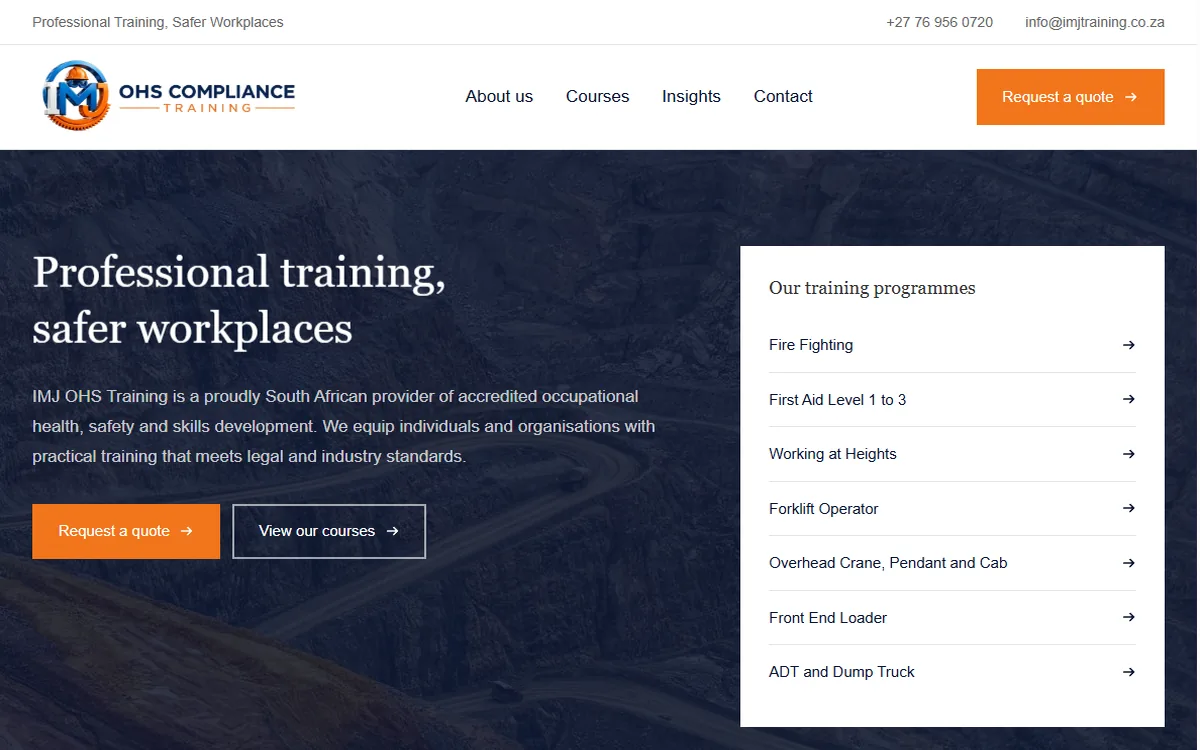
IMJ OHS Training is a Bloemfontein occupational health and safety training provider, trading as IMJ OHS Compliance Training (Pty) Ltd. Its focus is mining and heavy industry: fire fighting, first aid, working at heights, and the machines that do the heavy lifting on site, from forklifts and overhead cranes to front end loaders and articulated dump trucks. Training runs at the client’s own operation, on their own machines, or at a venue that suits them.
The company is new, so the website had to do something harder than look good. It had to make a young business credible to safety managers and procurement teams at large operations, without claiming a trading history it does not have. The site went live at imjtraining.co.za in September 2026.
A design that does not look like every other agency site
The first design we presented was a dark, modern layout with a floating menu and a large white headline over a dark hero. The client turned it down, and fairly: it looked like a generic agency template, not a safety training company. The client pointed us to the site of an established South African safety training provider they admired, with a light, plain corporate structure, a large logo and a grid of courses.
So we rebuilt it in that direction, reading the reference site’s actual typography and colours rather than guessing them, and applying IMJ’s own navy and safety orange from its logo. We also stripped out the patterns that make a site feel machine-made: numbered sections everywhere, identical hover cards, scrolling banners and punchy slogan headlines. The result looks like it belongs in the industry it serves.
Built as a custom CMS, not a WordPress theme
IMJ’s site is custom-coded with its own admin area. Everything the site displays can be edited there: pages and their headings, banner pictures, Google titles and descriptions, every course and e-learning course, the articles, the home page questions, contact details, and the quote form’s options. A preview mode lets the client check a change before it goes public.
Some details matter more than they look:
- Renaming a page writes its own redirect, so an old link keeps working instead of turning into a 404.
- Shared content is edited once. The “Why IMJ” points and core values appear on two pages each, so they live in one place and cannot drift apart.
- The legal wording stays locked. The POPIA consent sentence on the quote form is a legal statement, so it is not editable. The course tick boxes on that form come from the courses themselves, so a new course appears on the form automatically.
- Enquiries are saved before any email is sent. If the mail server ever fails, the lead is still in the admin area, which shows whether the notification went out.
This is the kind of build we mean by a custom CMS: the client can update everything they need to, without a theme, a page builder or a stack of plugins underneath. Our guide to static website vs WordPress vs custom CMS explains when that is the right choice.
Accuracy is the product
For a compliance training provider, a wrong claim on the website is not a typo. It is a claim about the law, or about a certificate, made in the company’s name. So the site treats accuracy as the main feature.
Accredited and aligned are kept apart. First Aid is accredited, through HWSETA and the Department of Employment and Labour. The machine and safety courses are aligned to the relevant SETA standards, which is a different thing, and each course page says which applies. Working at Heights carries no accrediting body, so its page names the regulation it is delivered against instead.
Legislation is cited, and linked to the source. Each course page sets out the actual legal basis for the training, and sixteen pages list the legislation they rest on, linked to the Department of Employment and Labour’s own documents. Every one of those links was checked before it was published. A reader, an auditor or an AI search engine can follow the link and check the claim instead of taking it on trust. Each legal section also carries a visible note that it is not legal advice.
The e-learning is described exactly. IMJ is a licensed INTRA (Intrasafe) training provider, and INTRA is a JWD client too. IMJ is licensed to present INTRA training material, and offers six INTRA e-learning courses, each with its own page. The material is non-credit bearing, the covers say so, and the site says so too. It never calls that material accredited.
A new company is described as a new company. The team’s experience is stated as the team’s experience, not turned into years of company trading.
Content that answers the questions buyers ask
The seven course pages run to roughly 850 to 1,000 words each. Each covers why the training matters, the legal basis, prerequisites, how delegates are assessed, what the certificate includes and how long it is valid, and a set of common questions. The six e-learning pages cover what each course teaches and who it suits.
Eight articles support the courses, one per course plus a piece on an employer’s duty to train under the Occupational Health and Safety Act. They carry a named author, Ian van Eeden, a director of IMJ, which gives search engines and readers a real person behind statements about safety law.
The search and AI groundwork
- Structured data on every page: the organisation and its local business details, each course, the articles with their legislation citations, the FAQs, and a catalogue of all thirteen programmes, which is what an AI assistant reads to answer “what training does IMJ offer”.
- Nothing invented in the markup. There are no star ratings or reviews in the schema, because IMJ does not have published reviews yet.
- A sitemap generated from the course catalogue, so it cannot go out of date when a course is added. All 28 URLs were checked live after launch.
- A robots.txt that names the search engines and AI crawlers it welcomes, plus an llms.txt summary for AI answer engines that states the accreditation position precisely, so a summary cannot blur accredited and aligned together.
- Phone and WhatsApp kept separate, in the visible contact details and in the structured data, because they are different numbers with different jobs.
Speed and accessibility
Before launch we measured the site with Google PageSpeed Insights on mobile and fixed what it found. The photo library went from about 100 MB to about 17 MB by resizing and recompressing every image, and the main hero image went from 890 KB to 187 KB. The mobile performance score went from 74 to 93, with Largest Contentful Paint down from 6.8 seconds to 3.1 seconds. Thirteen text contrast failures were reduced to one, which is the orange button colour, a brand decision left with the client.
Built so it can be run safely
The quote form asks for POPIA consent and quietly discards spam bots. The site sends security headers that restrict what can load on each page. The admin area is limited to admin accounts, so an ordinary login cannot open it. The terms and privacy policy are marked as drafts for the client’s attorney to review, because legal documents should be signed off by a lawyer, not a web designer.
The result
IMJ OHS Training launched with a site that looks at home in the mining and heavy industry world, describes its courses in real depth, separates accredited from aligned training precisely, and backs its legal statements with links to the law itself. The client can run all of it from the admin area without calling a developer for every change.
You can visit the live site, or see more of our work on the portfolio. For another safety training provider we have worked with, see the Capax case study.
Considering something similar?
If your business makes claims that have to be right, about the law, accreditation or safety, the website should be built to keep them right. Our custom CMS packages give you your own admin area without a plugin stack, and larger builds like this one are quoted per project. Request a quote and tell us what the site needs to do.
Frequently Asked Questions
How should a training provider show accredited and non-accredited courses?
Separately and precisely. Name the accrediting body only where a course is genuinely accredited, say “aligned” where it is aligned to a standard, and say nothing where neither applies. Mixing the two, even by accident, is a claim a client or an auditor can check and catch.
Why cite legislation on a training company’s website?
Because a claim that links to its source can be checked. Linking each legal statement to the official text makes the page more trustworthy for buyers and auditors, and more citable for search engines and AI assistants, which favour statements they can verify.
Can a training company update its own courses on a custom website?
Yes, if it is built with its own admin area. IMJ can add or edit courses, e-learning pages, articles, pictures and contact details, preview changes before they go live, and a new course automatically appears on the quote form.
Should each e-learning course have its own page?
Yes. A page per course means each one can be found in search for its own name and topic, can explain exactly what it covers and who it suits, and can be linked to directly when a client asks about it.
How do you build credibility for a new training company online?
By being precise rather than impressive. State the team’s real experience as the team’s, show the accreditations that genuinely apply, cite the law behind each course, and name a real person as the author. Buyers in safety-critical industries notice overstatement, and it costs more trust than it gains.