DPI Financial Services: From a Theme Demo to a Site of Their Own
DPI Financial Services is an independent financial planning practice, authorised as FSP 12892. It has been independent since 2002, and its principal has advised clients since 1989. The practice advises businesses and families in every province of South Africa on short-term insurance, investments, life cover and health cover.
On 29 October 2026 dpifinancial.co.za moved off WordPress and onto a custom site we built for the practice. This case study covers what was wrong with the old site, what the new one does differently, and why a practice that gets almost all of its work by referral still needed a better website.
Why a referral business still needs a good website
DPI does not chase strangers on Google. Clients arrive because another client sent them. That changes what the website is for, but it does not make it less important.
When someone is referred to a financial advisor, the first thing they do is look the practice up. They want to know whether it is real, whether it is authorised, what it actually does, and whether the people sound like someone they could talk to about money. The website is the second opinion on the referral. If it looks neglected, or reads like everyone else’s, the warm introduction cools before the phone ever rings.
So the brief was not “rank for everything”. It was: make the practice look as established and trustworthy online as it is in person, explain what it does in plain language, and make the first conversation easy to start.
Where it started
The old site was a single scrolling page on a bought WordPress theme. We audited it in August 2026, before quoting, and found problems on almost every layer:
- Someone else’s pictures. The rotating banner at the top of the home page used the theme’s own demo images, the ones that ship with the theme for every buyer.
- Pages with nothing on them. The site had three separate pages. Each one had a heading, a stock photo and a contact form, and no text at all.
- Services hidden behind arrows. Ten services sat inside a sliding carousel, so most of them were never seen unless a visitor clicked through. The descriptions averaged 49 words each, which is a teaser, not an explanation.
- A blog that was not theirs. The blog held over 300 posts, published twice a week like clockwork. A search on a few distinctive sentences showed the same articles published word for word on other South African advisory sites. They were a licensed content subscription. To Google that is duplicate content, which is why 300 posts were earning the practice very little.
- A spam check that checked nothing. The contact form had a tick box labelled “I am not a robot”. Ticking it verified nothing.
- Menu links on the insecure address. The menu pointed to the http version of the site, so every click on the menu went through an extra redirect.
- Errors in the background. The server’s error log held 40 PHP fatal errors between August 2023 and February 2026, all from a leftover WordPress language file.
None of this was anyone’s fault in particular. It is what happens to a theme site that was set up once and then left to run for years. But the result was a practice with decades of experience presenting itself through a demo slider and someone else’s articles.
What we built
A site about the practice
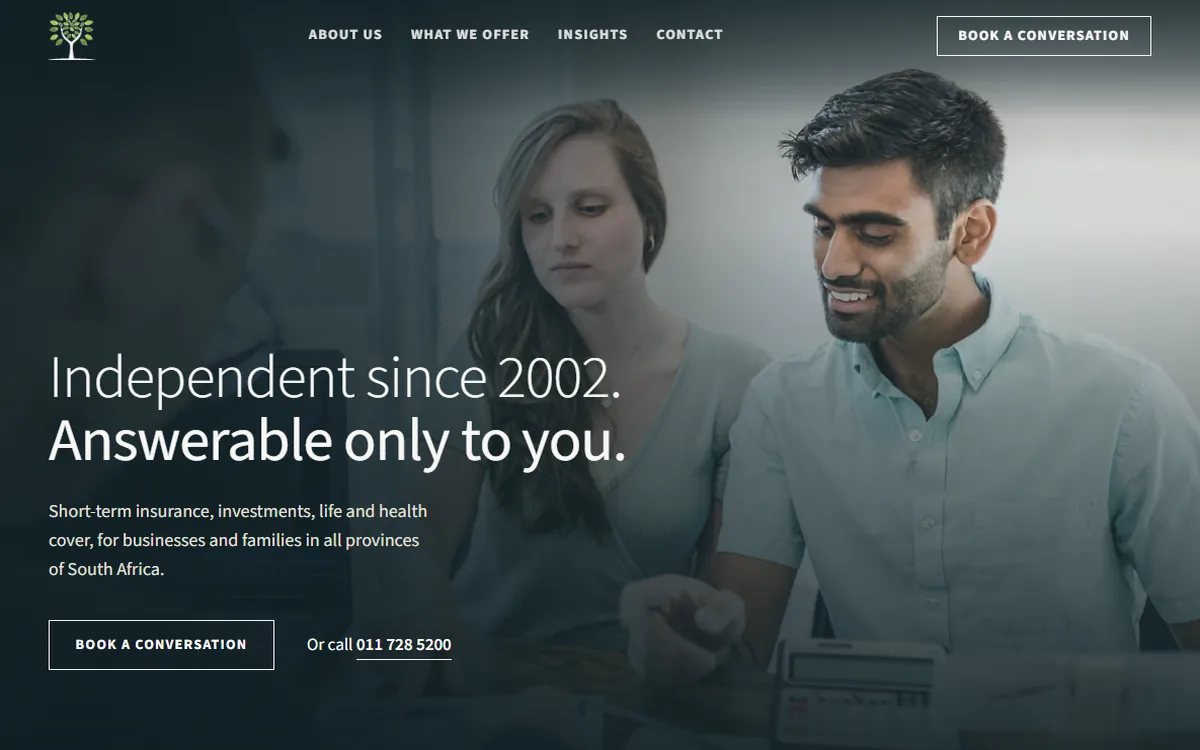
The new site is built around one idea: advice measured in decades. The home page states it plainly (“Independent since 2002. Answerable only to you.”) and then shows what working with DPI looks like as time passing rather than numbered steps: hour one is a conversation, week one is laying out what you already have, month one is a written plan, and year thirty is “still here”. For a practice whose clients stay for decades, that says more than a list of features could.
The navigation is four items: About Us, What We Offer, Insights and Contact. Every page carries the FSP number and a short disclaimer in the footer, and the phone number is one tap away in the header.
Four clear areas of advice
The ten old service cards were grouped into four areas, each with its own page: short-term insurance, investments, life insurance and health insurance. Each page explains what is covered (for example, investments covers pre-retirement planning, post-retirement planning, discretionary investments, and wills and estates) and the questions DPI helps clients answer.
Four proper pages are easier to read than ten slivers in a carousel, and each one gives search engines and AI assistants something substantial to understand.
15 new articles, written for South Africans
We did not carry the licensed blog across. In its place we wrote 15 new articles on the questions South African clients actually ask: the two-pot retirement system, SASRIA cover, gap cover, the average clause, retirement annuity versus tax-free savings, living versus life annuities, cyber insurance and POPIA for small businesses, and more.
Each article is written in plain language, ends with a short “Common questions” section and lists its sources. The tax figures were taken from the official SARS Budget 2026 tax guide. Every article says clearly that it is general comment, not personal advice, which matters for an authorised financial services provider. The practice can publish new articles, and schedule them for a future date, from its own admin area.
Enquiries that cannot get lost
There are two ways to get in touch. The contact page has a full enquiry form, and every page ends with a short callback request: a name and a phone number, nothing more. For someone who has just been referred and wants to talk, that is the easiest possible first step.
Both forms are protected by Cloudflare Turnstile, a real spam check that replaced the tick box, plus hidden spam traps. Every enquiry is saved in the practice’s admin area as it arrives, so even if an email were ever delayed, no enquiry is lost.
Compliance information where people can find it
A disclaimer page sets out the practice’s authorisation, that the site is general information only, investment risk, and how to complain. A privacy policy explains what the forms collect and why. These are things a cautious client, or a compliance officer, looks for on an advisor’s site.
Moving without broken links
The old site had 348 blog posts and 3 pages. None of the posts came across, but every one of those 351 old addresses now redirects permanently to the new Insights page, so a link to an old article in an email, a bookmark or a search result still lands somewhere useful instead of an error page. Old WordPress admin addresses go to the home page, and the old WordPress sitemaps redirect to the new one.
We tested a sample of the old addresses on the live site after launch, and each one landed on the new site.
Search, AI search and analytics
Even for a referral business, the practice should come up properly when someone searches its name:
- Structured data. The site describes DPI to search engines as a financial service, with its FSP number and South Africa as its service area. Each article carries article and FAQ markup.
- Search Console and Bing. The site is verified in Google Search Console and Bing Webmaster Tools, with the new sitemap submitted to both.
- Analytics that count what matters. Google Analytics 4 records completed enquiries as a key event, along with clicks on the phone number and email address. The first test enquiry and test clicks were confirmed in the live reports on launch day.
- Readable by AI. The site publishes an llms.txt file and an AI catalogue, which give AI assistants a clean summary of the practice, its services and its articles.
We ran Google PageSpeed Insights on the live home page on 29 October 2026:
| Performance | Accessibility | Best Practices | SEO | |
|---|---|---|---|---|
| Mobile | 96 | 100 | 100 | 100 |
| Desktop | 97 | 100 | 100 | 100 |
Both runs passed all four of PageSpeed’s Agentic Browsing checks, which look at whether AI assistants can read and use the page. These are lab scores from a single run, and scores move a few points between runs. We did not measure the old site’s speed before it was replaced, so we do not quote a before and after figure.
What DPI gets out of it
- A site that matches the practice. No demo images, no borrowed articles. The site says what DPI does, in DPI’s own terms.
- A better second opinion on every referral. Someone checking the practice out finds its authorisation, its services and its approach in under a minute.
- An easy first step. A callback request on every page, and a full enquiry form, both protected against spam.
- Articles that are its own. 15 original articles, with the tools to publish more.
- Nothing broken behind it. Every old address redirects, and the old WordPress install, with its error log, is gone.
This is another example of a site moved off a WordPress theme onto a custom build. For how that compares with staying on WordPress, read static website vs WordPress vs custom CMS, and for the signs that a site needs rebuilding rather than patching, see website redesign: when and why to rebuild your site. Everything else we have built is on our portfolio.
Considering something similar?
If you run an advisory practice or a brokerage, our guides to website design for financial advisors and website design for insurance brokers cover what those sites need. The cost depends on the number of pages, how much new writing is needed, what has to be redirected from the old site and whether you want your own admin area. Our website packages are the starting point, and anything beyond them is quoted on scope. Request a quote and we will tell you honestly what you need.
Frequently Asked Questions
What should a financial advisor’s website include?
At minimum: the FSP number, a clear explanation of what you advise on, how to get in touch, a disclaimer and a privacy policy. DPI Financial Services’ site adds a page for each of its four areas of advice, 15 plain-language articles, a callback request on every page and a disclaimer page that explains how to complain.
Does a referral-based practice need a website?
Yes. Most referred clients look the practice up before they call. The website is where they check that it is authorised, what it does and whether it seems trustworthy. A neglected site can cool a warm referral before the first conversation.
Should a financial advisor use a licensed blog subscription?
Be careful. Licensed articles are often published word for word on many advisors’ sites, and search engines treat that as duplicate content, so it rarely brings in visitors. DPI’s old site had over 300 such posts. The new site replaced them with 15 original articles written for South African readers.
What happens to old blog links when a site is rebuilt?
If they are not redirected, they show an error page. On dpifinancial.co.za all 351 old blog and page addresses redirect permanently to the new Insights page, so old links still work.
How do you stop spam on a website contact form?
A tick box that says “I am not a robot” stops nothing on its own. DPI’s new forms use Cloudflare Turnstile, which checks visitors in the background, plus hidden fields that catch automated submissions. Every genuine enquiry is also saved in the admin area.
Is DPI Financial Services’ website still on WordPress?
No. Since 29 October 2026 dpifinancial.co.za runs on a custom site built by JWD, with its own admin area for publishing articles and reading enquiries.