Waterjetting SA: A Website Case Study
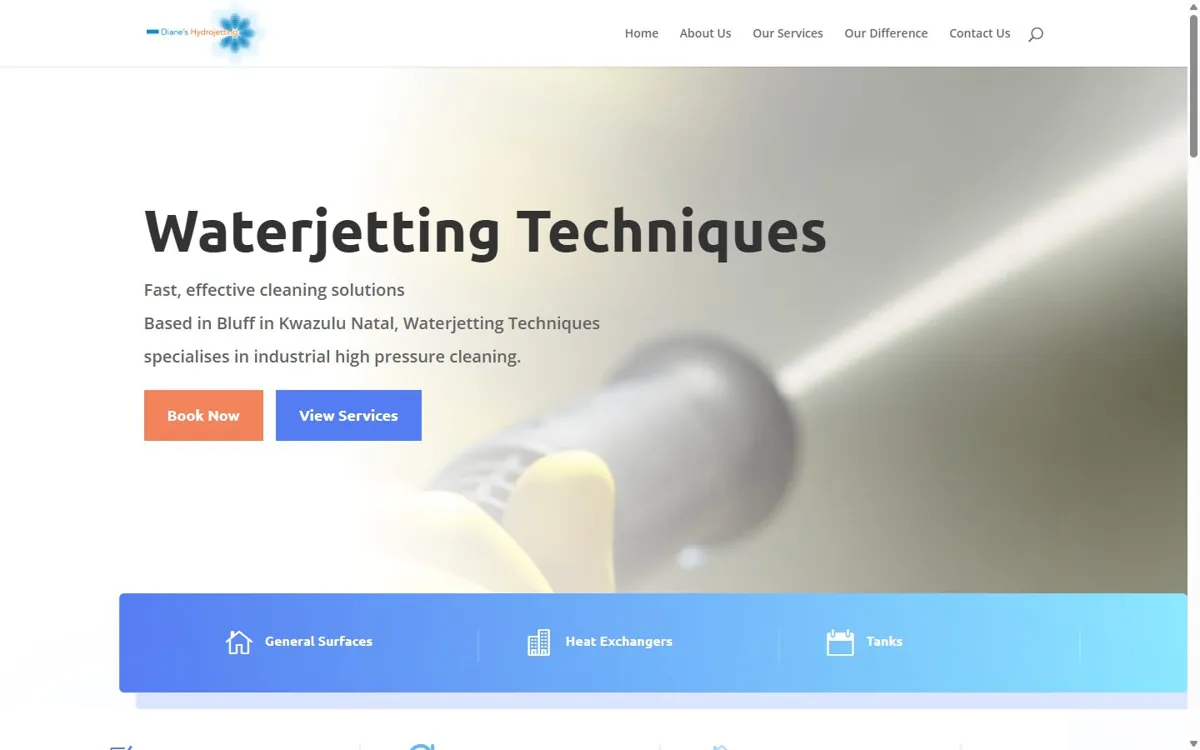
Waterjetting SA, trading as Waterjetting Techniques, specialises in industrial high pressure cleaning from its base in Bluff, KwaZulu Natal. The company is led by CEO Nelson Govender, who brings 23 years of experience as a fitter and turner in the sugar and chemical industries, alongside Diane Govender in customer relations and marketing. The business is 100 percent BEE rated and black woman owned, and counts sugar industry names Hullets and Illovo among its clients.
About Waterjetting SA
The core waterjetting service covers surface preparation, boiler tube cleaning, tank cleaning, drain clearing, heat exchanger cleaning, cold cutting, and hydro demolition, using equipment rated across a genuinely wide pressure range, 750 to 2,800 bar, depending on the job. Beyond waterjetting itself, the business also offers plant, hygiene, and office cleaning, staffing solutions supplying welders, fitters, boilermakers, and electricians, plant hire, mechanical engineering including turning, machining, and fabrication, and civils and maintenance work.
That is a genuinely wide operational footprint for one company, spanning specialised high pressure cleaning, skilled trade staffing, and general engineering, all serving heavy industry.
What the website needed to do
With services spanning such distinct disciplines, from technical waterjetting through to staffing and engineering, the site needed clear separation so an industrial buyer searching for one specific need, tank cleaning ahead of a shutdown, or skilled fitters for a short term contract, could find the right service quickly rather than treating the company as a single undifferentiated industrial contractor.
The BEE rating and named client relationships (Hullets, Illovo) needed real visibility too, since both function as concrete, verifiable proof of standing and capability in an industry where procurement decisions often weigh BEE status and demonstrated experience with recognisable clients heavily.
Why this matters for industrial services and staffing businesses generally
For any business operating across multiple industrial service lines, clarity about what is actually offered under one roof prevents a buyer from either missing a relevant service or, worse, assuming the company is a narrow specialist when it can in fact cover a broader scope of a project. Naming real client relationships, where the relationship allows it, does more credibility work than general claims of industrial experience.
BEE status is also a genuine, often procurement-critical fact for South African industrial and mining sector buyers, and stating it plainly, rather than leaving a buyer to ask, removes friction from an early stage of many supplier evaluation processes.
The result
Waterjetting SA’s site is live now at waterjettingsa.co.za, built to present the company’s full range of industrial services, its BEE status, and its real client relationships clearly to industrial procurement buyers. It is one of the businesses featured on our portfolio.
Considering something similar?
Multi discipline industrial services businesses vary in cost depending on how many service lines and credentials need presenting. Our Business Website package is the usual starting point. Request a quote and we can confirm exact pricing for your business.
Frequently Asked Questions
How much does a website for an industrial services company cost?
It depends on how many service lines and credentials need presenting. Our Business Website package is the usual starting point, and we confirm exact pricing once we understand your business.
Why does BEE status matter on an industrial company’s website?
Because it is often a genuine, procurement-critical factor for South African industrial and mining sector buyers. Stating it plainly and prominently removes friction early in a supplier evaluation process rather than leaving a buyer to ask or search for the information.
Should named client relationships be featured on an industrial website?
Yes, where the relationship genuinely allows it. Real, named client relationships in a recognisable industry are far more convincing to a technical or procurement buyer than general claims of industrial experience, since they are concrete and effectively self-verifying.
How should a company with multiple distinct industrial services organise its website?
By separating each service line clearly, technical cleaning, staffing, engineering, and so on, rather than presenting one undifferentiated “industrial services” offering. A buyer with one specific need should be able to find the relevant service quickly without wading through unrelated offerings.
What matters most for an industrial staffing and services business’s credibility?
Specific, verifiable proof: real equipment specifications, named clients, formal certifications like BEE status, and leadership experience genuinely relevant to the industries served. Vague claims of quality or reliability carry far less weight with this kind of technical, procurement-driven buyer.
How long does a website project for an industrial services company take?
We confirm the timeline once the scope is agreed. It depends on scope, since presenting multiple service disciplines, real equipment specifications, and formal credentials accurately takes real coordination with the client to get right.
Should leadership experience be featured on an industrial company’s website?
Yes, where it is genuinely relevant to the work. A CEO or founder with real, hands-on industry experience, rather than a purely administrative background, is a meaningful credibility signal for technical buyers evaluating whether a company truly understands their sector.
How should a company presenting a wide equipment pressure range explain it to buyers?
By connecting the range to real use cases rather than listing numbers alone. Explaining that lower pressures suit delicate surface preparation while higher pressures handle heavier tasks like hydro demolition helps a buyer without deep technical knowledge understand why the range matters for their specific job.