Alutron Tactical: A Website Case Study
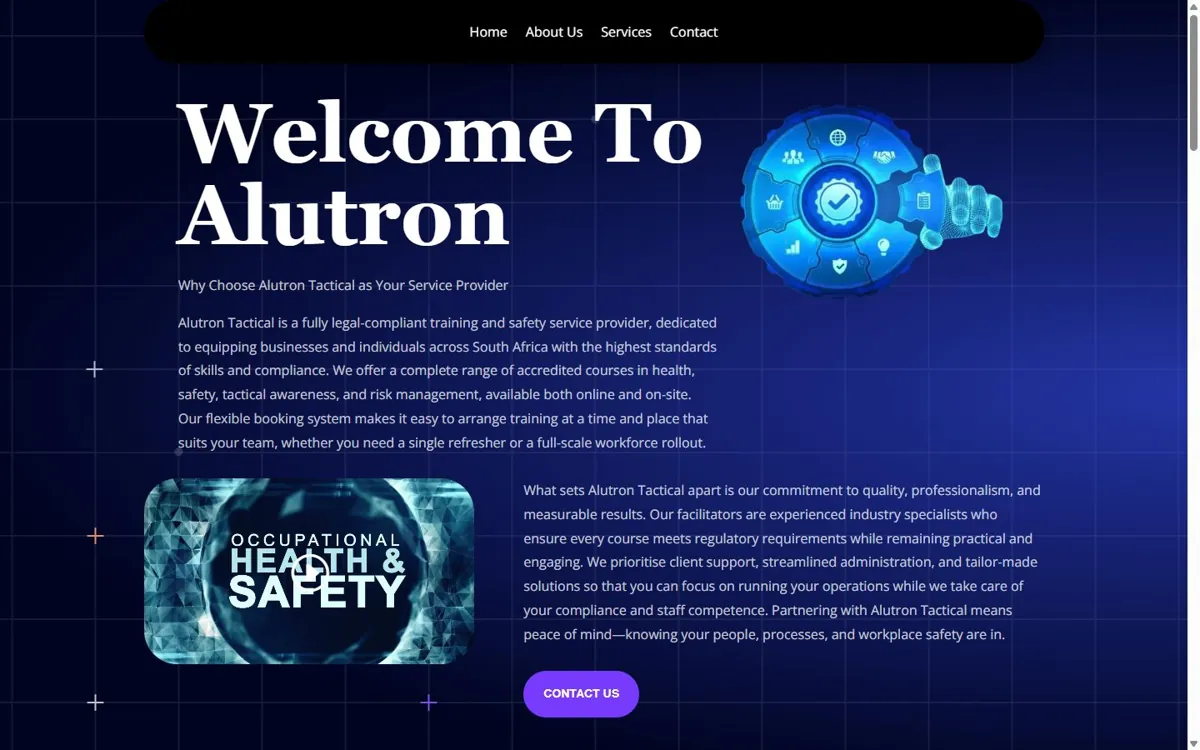
Alutron Tactical is a health, safety, and tactical awareness training provider based in Gonubie, East London, describing itself as a fully legal compliant training and safety service provider offering accredited courses in health, safety, tactical awareness, and risk management. Courses are delivered online, virtually, and on site, giving clients flexibility in how their teams are trained.
About Alutron Tactical
The course list is practical and workplace focused: OHSA training, an AIDStrac course, Hazard Identification and Risk Assessment (HIRA), Noise Induced Hearing Loss and Regulations (NOISETRAC), Personal Hygiene for Perishable Food Safety (FOODSAFE), and Use and Care of Hand Tools (TOOLTRAC). Each course is built around a specific, named workplace risk rather than being a generic safety overview.
Several of those courses, including AIDStrac, NOISETRAC and TOOLTRAC, are INTRA courses: Alutron Tactical is a licensed INTRA (Intrasafe) training provider, presenting INTRA health and safety training material. INTRA is a JWD client too, so we know the material these courses are built on.
Named, specific courses like these make it far easier for a buyer, usually someone responsible for workplace compliance, to match a course directly to an actual identified risk or requirement.
What the website needed to do
With courses spanning multiple distinct workplace risks, from noise exposure to food hygiene to hand tool safety, the site needed to present each as its own clear offering rather than folding them into one undifferentiated “training” page, since a buyer usually has one specific compliance gap they are trying to close.
The flexibility of delivery format (online, virtual, or on site) also needed clear visibility, since this is a real, practical consideration for a business deciding how to train staff across different sites or shift patterns.
Why this matters for workplace safety training providers generally
For any business selling workplace safety or compliance training, specificity is what actually converts. A generic “workplace safety training” page tells a buyer very little about whether a provider covers their exact need, while named courses tied to specific, recognisable risks (noise exposure, food hygiene, hand tool safety) let a compliance officer confirm a match immediately.
Delivery flexibility is also a genuine differentiator worth stating clearly, since businesses training staff across multiple sites or working around shift patterns often specifically need a provider who can accommodate more than one delivery format.
The result
Alutron Tactical’s site is live now at alutron.co.za, built to present each named safety course clearly alongside the flexible online, virtual, and on-site delivery options. It is one of the businesses featured on our portfolio.
Considering something similar?
Workplace safety and compliance training providers vary in cost depending on how many courses need their own content. Our Business Website package is the usual starting point. Request a quote and we can confirm exact pricing for your course catalogue.
Frequently Asked Questions
How much does a website for a safety training provider cost?
It depends on how many courses need their own content and how much accreditation detail needs to be presented. Our Business Website package is the usual starting point, and we confirm exact pricing once we understand your catalogue.
Why should safety courses be named specifically rather than grouped generically?
Because a compliance buyer is usually trying to close one specific identified risk or requirement, and a generic “training” page does not let them confirm quickly that a provider covers exactly what they need. Named, specific courses tied to recognisable risks convert better.
Does delivery format flexibility matter for a training provider’s website?
Yes, where genuinely offered. Businesses training staff across multiple sites or around shift patterns often specifically need a provider who can deliver online, virtually, or on site, and stating this clearly can be a real deciding factor.
How should a training provider handle claims of accreditation?
As specifically as possible, naming the actual accrediting or recognising body wherever that information is available, since a vague “accredited” claim gives a compliance conscious buyer little to actually verify.
What kind of buyer searches for workplace safety training?
Usually someone responsible for compliance within a business, an HR manager, safety officer, or business owner, acting against a specific identified risk or legal requirement, rather than an individual browsing for personal interest.
How long does a website project for a safety training provider take?
Most projects like this run three to five weeks from a signed off brief to launch, with the timeline mostly depending on how many distinct courses need their own clear content and how much accreditation detail needs to be gathered and confirmed.
Should a training provider state which national standards its courses meet?
Yes, as specifically as possible. A compliance buyer needs confidence that a course actually satisfies a real legal or regulatory standard, and naming the specific standard, rather than a general “meets national requirements” claim, gives them something concrete to verify.
Does location matter for a training provider offering online delivery?
Less than for a purely on-site business, but a stated physical base still builds credibility and matters for clients who specifically want on-site training at their own premises, so it is still worth including clearly.
Should course names, like specific abbreviations or programme titles, be explained on the site?
Yes. Industry-specific course names and abbreviations are meaningful to someone already familiar with compliance training but can be confusing to a first-time visitor, so briefly explaining what each course actually covers alongside its formal name helps a wider range of visitors find what they need.