Dauremas: A Website Case Study
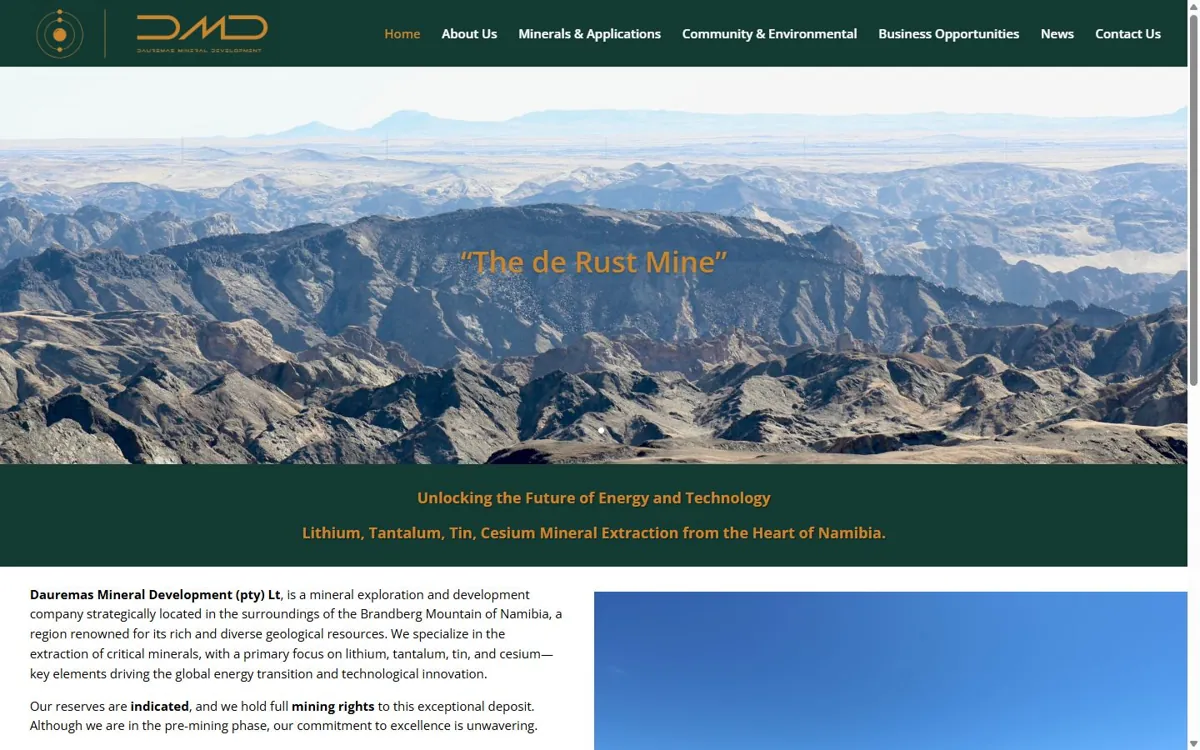
Dauremas Mineral Development is a mineral exploration and development company targeting critical minerals, lithium, tantalum, tin, and cesium, at a site called the de Rust Mine, surrounding the Brandberg Mountain in Namibia. The company states it holds full mining rights and describes its indicated reserves, with an explicit focus on ESG and community engagement alongside the technical exploration work.
About Dauremas
The company is currently in what it describes as a pre-mining phase, developing the de Rust Mine towards production. Critical minerals like lithium and tantalum sit at the centre of global battery and electronics supply chains, which puts a project like this in front of a specific, sophisticated audience: potential investors, industry partners, and regulators, rather than a general retail customer base.
What the website needed to do
A mineral exploration company’s website is doing a different job to almost any other business on this list. It is not trying to generate everyday enquiries. It is building credibility with people who understand the mining and minerals sector well enough to scrutinise claims about reserves, rights, and project status, and who expect a level of seriousness and clarity that matches the scale of what is being described.
That meant the site needed to state the project’s facts (location, minerals targeted, project phase, mining rights) clearly and without exaggeration, since this is an audience that will notice overreach immediately. It also meant giving real space to the ESG and community engagement side of the business, since that is now a standard expectation for any credible exploration or mining project, not an optional extra.
Why this matters for exploration and mining companies generally
Investor and partner trust in this sector is built on precision, not persuasion. A mining or exploration company’s website succeeds by being clear, factual, and appropriately cautious about claims (using language like “indicated reserves” rather than overstating certainty), because the audience reading it includes people who will hold the company to exactly what it said. Overpromising here does real reputational damage in a way it might not for a more consumer-facing business.
Project status also matters more here than for most businesses. A site needs to be honest about where a project actually sits, exploration, pre-mining, or production, since that materially changes how a reader should interpret everything else on the page.
Naming a specific project, in this case the de Rust Mine at Brandberg Mountain, rather than describing the company’s work only in the abstract, also gives investors and partners something concrete to research independently. A vague description of “mineral exploration activities” invites more scepticism than a named project a reader can look into on their own terms.
Geographic and geological specificity matters too. Naming the actual landmark, Brandberg Mountain, and describing the region honestly gives a technically literate reader real context to evaluate the project against their own knowledge of the area, rather than asking them to trust a description with no independently checkable anchor point.
The result
Dauremas’s site is live now at dauremas.com, built to present the de Rust Mine project clearly to an audience of investors, partners, and regulators, with the company’s ESG and community commitments given real space alongside the technical detail. It is one of the projects featured on our portfolio.
Considering something similar?
Exploration, industrial, and technical projects like this vary widely in cost depending on complexity. Our Business Website package is the usual starting point for presenting a project’s status, credentials, and ESG commitments. For genuinely complex needs, such as investor data rooms or integrations, see our custom development work. Request a quote and we can confirm exact pricing for your project.
Frequently Asked Questions
How much does a website for a mining or exploration company cost?
It varies widely depending on complexity. Our Business Website package is the usual starting point; projects needing investor portals, data rooms, or other custom functionality move into custom development, scoped and quoted individually.
What should a mining or exploration company’s website prioritise?
Clarity and precision above persuasion. State the project’s actual status, location, and targeted minerals plainly, and be careful with language around reserves and rights, since the professional audience reading the site will notice any overstatement immediately.
Does an exploration company need to cover ESG on its website?
Yes. ESG and community engagement are now standard expectations for credible mining and exploration projects, not optional extras, and giving this real space on the site signals the project takes it seriously rather than treating it as a compliance afterthought.
Who is actually the audience for a mining company’s website?
Mostly investors, industry partners, and regulators rather than everyday customers. The site should be written and structured with that sophisticated, scrutinising audience in mind, not adapted from a typical consumer business template.
How is project phase communicated honestly on a website like this?
By stating plainly where the project actually sits, for example exploration, pre-mining, or production, rather than implying a more advanced stage than is accurate. This single detail changes how a reader interprets everything else on the site.
How long does a website project for an exploration or mining company take?
Most projects like this run four to six weeks from a signed off brief to launch, since accurately presenting reserves, rights, and project status takes careful review with the client before anything goes live. Getting the technical and legal detail right matters more than moving fast for a website read by investors and regulators.