Print Impact: From Price Lists to an Enquiry Cart
Print Impact is a large format printing and signage company in Marlboro, Sandton. Its slogan is “Affordable Online Quality Printing”, and its range runs from roller banners and branded gazebos to 3D letters, lightboxes, building wraps, billboards and aerial banners.
On 27 October 2026 printimpact.co.za moved off WordPress and WooCommerce and onto a custom site we built for the company. This case study covers what the brief asked for, how the new site works and how we made sure nothing was lost in the move.
The brief
The old site was a WordPress shop with WooCommerce. It listed products with prices, and some of those prices belonged to specials that had long since ended. Print Impact wanted three things from the rebuild:
- No prices online. Most print jobs depend on size, material, finishing and artwork, so a fixed online price is often wrong. The company wanted customers to choose what they need and ask for a quotation.
- Keep everything. Every product, page, article and photograph had to come across.
- No more WordPress. The company wanted a site it could edit fully itself, without themes and plugins to keep updated.
What we built
An enquiry cart instead of a checkout
Every product page works like a shop page, without the price. On the branded gazebo, for example, a customer picks one of six frame sizes, chooses side walls from nine options, says whether the artwork is print ready or needs design help, sets the quantity and adds a note. Then they press Add to enquiry.
The enquiry builds up like a shopping cart. On the enquiry page the customer can change quantities, add notes per item and upload artwork for each item, up to five files of 20 MB each. They add their details, the delivery or installation area and the date they need it by, and send everything in one go.
Each enquiry is saved in Print Impact’s admin with a reference number, the artwork files and a status the team updates as the quote progresses. The team can reply by email straight from the enquiry.
A site that looks like a print company
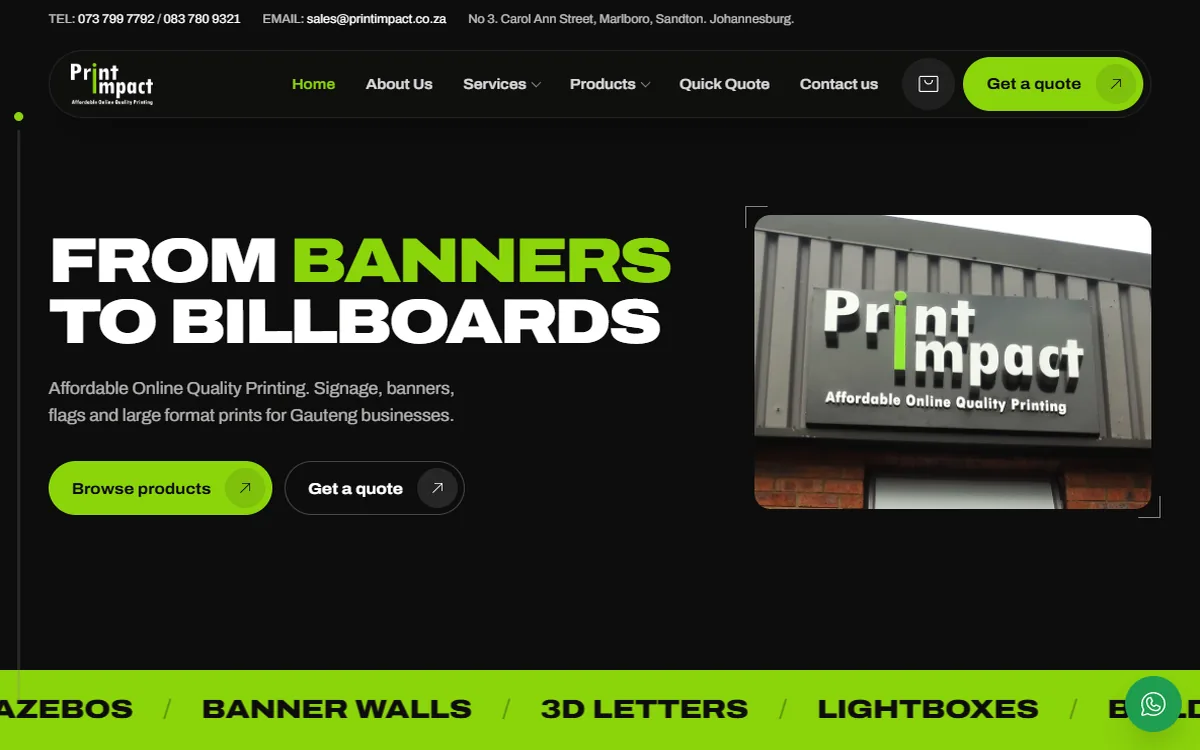
The design idea is the company’s own range: from banners to billboards. The home page leads with that line, and the pages run from small items to large ones. The brand’s black and lime green are kept, the scroll indicator is drawn from the lime “i” in the Print Impact logo, and the photographs carry crop marks, the trim lines every printer knows.
Phone numbers and the email address sit at the top of every page, and a WhatsApp button stays on screen.
An admin the team controls
Print Impact edits everything from its own admin area: products with their options, photographs and download templates, categories, pages and articles. Pages are built with a drag and drop page builder that uses Print Impact’s own design blocks, so new pages match the rest of the site. Menus, redirects, settings and the media library are all in the same place, along with every form submission: quote requests, contact messages, quick quotes, service ratings and newsletter sign ups.
Moving without losing anything
A site that has been running for years collects addresses: product pages, old image links in emails and on social media, PDF templates, attachment pages, tag pages and old sitemaps. Before launch we took every public address the WordPress site could produce, 968 of them, from its own database and its files, and replayed each one against the new site. All 968 reached a working page, either at the same address or through one permanent redirect.
After launch we tested a spread of old addresses on the live site again, including an old image link, an attachment page, a product category, a tag page and a product. Each one landed on the right page.
Along the way we found two pages on the old site that had been returning a server error, including the large format printing and signage page. Their content and their 54 photographs were recovered from the old database and rebuilt as galleries.
Search, AI search and speed
- Every page described. Titles and descriptions carried over from the old site, cleaned of leftover template code and old prices, with new descriptions written for the pages that had none.
- Structured data on every page. The business is described as a local business with its address and contact details, the shop and category pages list their products, and articles are marked up as articles. Products are described as services rather than priced products, because a product listing without a price produces errors in Google Search Console.
- Readable by AI. The site publishes an llms.txt file and an AI catalogue, and its robots file welcomes search engines and AI answer engines.
We ran Google PageSpeed Insights on the live home page on 11 November 2026:
| Performance | Accessibility | Best Practices | SEO | |
|---|---|---|---|---|
| Mobile | 99 | 100 | 100 | 100 |
| Desktop | 99 | 100 | 100 | 100 |
Both runs passed all four of PageSpeed’s Agentic Browsing checks, which look at whether AI assistants can read and use the page. These are lab scores from a single run, and scores move a few points between runs. We did not measure the old site’s speed before it was replaced, so we do not quote a before and after figure.
What Print Impact gets out of it
- Enquiries with everything in them. Sizes, options, quantities, artwork and deadlines arrive together, instead of in a back and forth over email.
- No out of date prices. Customers ask for a quote, and the team prices each job properly.
- A site it runs itself. Products, pages and articles are edited in its own admin, with no WordPress, theme or plugins to maintain.
- Nothing broken behind it. Every old address still works.
For how a custom site with its own admin compares with WordPress, read static website vs WordPress vs custom CMS. For the signs that a site needs rebuilding rather than patching, see website redesign: when and why to rebuild your site. Everything else we have built is on our portfolio.
Considering something similar?
If your prices depend on the job, an enquiry cart can work better than a checkout. The cost of a build like this depends on the number of products and options, how much content comes across from the old site and what the admin needs to do. Our website packages are the starting point, and anything beyond them is quoted on scope. If you want to move an existing site, see our website migration and takeover service, or request a quote and we will tell you honestly what you need.
Frequently Asked Questions
What is an enquiry cart?
An enquiry cart works like a shopping cart without prices or payment. Customers choose products and options, add them to an enquiry and send it, and the business replies with a quotation. Print Impact’s version also lets customers upload artwork for each item and say when they need the job done.
Should a printing company show prices on its website?
It depends on the work. Where the price changes with size, material, finishing and artwork, a fixed online price is often wrong, and specials go out of date. Print Impact chose to remove prices and quote every job, so customers always get a price for exactly what they need.
What happens to old links when a shop moves off WooCommerce?
They break unless they are redirected. Before Print Impact’s new site went live, all 968 public addresses from the old WordPress shop were tested against the new site, and every one reached a working page, either at the same address or through a single permanent redirect.