OMNIBID Lawns: A Website Case Study
OMNIBID Lawns is an owner-operated lawn and garden care business based in South Morang, in Melbourne’s northern suburbs in Victoria, Australia. The business trades as Omnibid Pty Ltd and is run by its owner, Jason Smith. It mows lawns and nature strips, edges and whipper snips, trims hedges, weeds garden beds and does garden clean-ups and property maintenance, on a regular schedule or as a one-off job.
It is also one of our international builds. We designed and built the site from Cape Town for a client on the other side of the Indian Ocean.
About OMNIBID Lawns
The site lists fourteen suburbs across Melbourne’s north: South Morang, Mill Park, Epping, Mernda, Doreen, Wollert, Lalor, Thomastown, Bundoora, Plenty, Whittlesea, Greensborough, Diamond Creek and Yarrambat. The business states that it is GST registered and carries public liability insurance.
Beyond households, the site speaks directly to property managers, landlords and owners corporations. That last group is a distinctly Australian audience: an owners corporation manages the shared grounds of a strata property, and it buys lawn care very differently to a homeowner, on a schedule, across a whole site, with someone accountable for the result.
What the website needed to do
A lawn care business lives or dies on one conversion: the quote request. Nobody buys lawn mowing from a brochure. They want to know what it will cost for their yard, and the honest answer depends on the yard.
So the site was built around getting a good quote request, not just any enquiry. Three problems shaped almost every decision.
The job is visual, and customers are standing in it. The fastest way for Jason to quote accurately is to see the property. The quote form therefore accepts photos, and customers are prompted to “Send photos for a quote” straight from the homepage.
Phone photos are enormous. A photo taken on a modern phone can run to several megabytes, and a customer standing in their backyard on mobile data will not wait for three of them to upload. The form compresses photos in the browser before they are sent and shows upload progress, so the submission actually completes instead of timing out halfway.
How often matters as much as what. Lawn care is sold by frequency as much as by service. The site offers weekly, fortnightly, three-weekly, monthly and one-off, each with a plain sentence explaining who it usually suits, so a customer can choose sensibly rather than guess.
Built without a CMS, on purpose
This site has no content management system and no admin area. That was a deliberate choice, not a shortcut.
An owner-operator who spends his days on other people’s lawns does not need to log into a dashboard to maintain his website, and every plugin and admin login is one more thing to patch and one more way in. The site is generated as static pages from a single file of business facts, with one PHP script handling the quote form.
That single source of truth matters more than it sounds. Every service, suburb, frequency and FAQ lives in one place, and anything the client had not supplied yet is left empty and simply hidden by the build rather than filled with a placeholder. No invented values reach the page.
The quote form emails Jason with the customer’s photos attached, sends the customer a confirmation, and logs each enquiry. It rejects obvious spam with a hidden honeypot field, a minimum completion time, an hourly rate limit, and a check that uploaded files really are images.
Designed to look like a local business, not a template
The first version of the homepage had a 3D animated grass hero. It was removed. So were pill-shaped buttons, a floating header and a scrolling list of suburb names. Each of those looked impressive in isolation and made the site feel less like a real, local, owner-run business.
What replaced them is quieter and more direct: squared controls, a full-width header, one typeface throughout, and a deep forest green with lime and yellow highlights sampled from the OMNIBID logo. The logo itself was rebuilt so it works cleanly on both light and dark backgrounds.
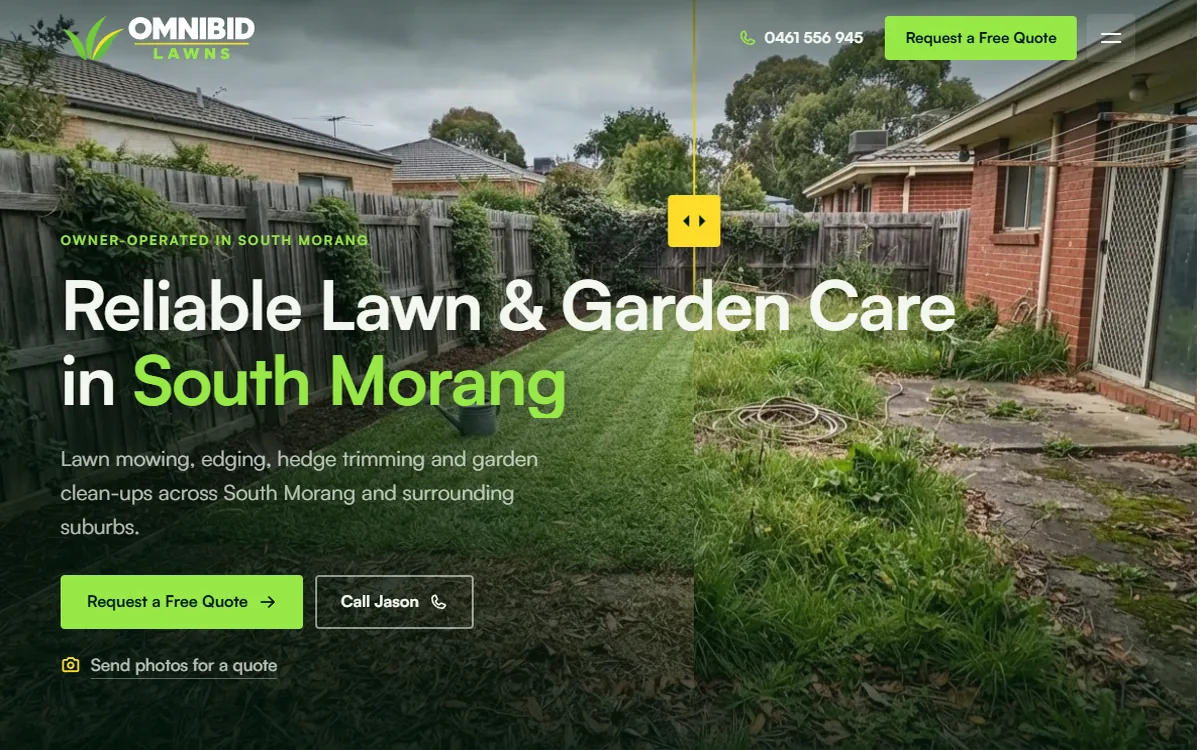
The homepage hero is a before and after comparison. A cut line sweeps across the image once both photos have loaded, and visitors can drag it, or move it with the arrow keys, to compare the two. In testing, an earlier version of that sweep that repainted the image scored 59 for desktop performance in PageSpeed Insights, so it was rebuilt to animate with a transform instead.
Built to be found
For a business that covers a defined patch of suburbs, local search is the channel that matters. The site carries LocalBusiness structured data, and we confirmed through Google’s own Rich Results Test that Googlebot crawls the live site successfully and reads that markup as valid.
Pages move between each other with native view transitions, and likely next pages are prerendered when a visitor hovers a link, so navigating the site feels immediate on a decent connection.
Working across the time difference
Melbourne is eight hours ahead of South Africa, and nine during Australian daylight saving. There is a short live overlap at the end of the Australian working day, which is the start of ours. We used it for anything that needed a real conversation, and handled everything else in writing, so work carried on while the client was offline.
For a straightforward build like this, that arrangement works well. Our guide to working with a remote web design team across time zones sets out how we run it.
The result
The OMNIBID Lawns site is live at omnibidlawns.com.au, built around a photo-led quote request, clear service frequencies, the fourteen suburbs the business covers, and a dedicated path for property managers and owners corporations. Jason left a review of the project on our site, and OMNIBID Lawns is one of the businesses featured on our portfolio.
Considering something similar?
Service businesses outside South Africa can work with us the same way OMNIBID Lawns did. Our article on why international businesses hire web designers in South Africa covers how it works in practice, and our Business Website package is the usual starting point. Pricing is set in rand, so the figure in your currency depends on the exchange rate at the time. Request a quote and we can confirm exactly what your project needs.
Frequently Asked Questions
Can a South African web designer build a website for an Australian business?
Yes. OMNIBID Lawns in Victoria is one example. The work is done remotely, the site is hosted where the client chooses, and the parts that need a live conversation are scheduled into the short overlap between the two working days.
Should a lawn care website let customers upload photos?
For most lawn and garden businesses, yes. Seeing the property is the quickest route to an accurate quote. The important detail is compressing the photos in the browser before upload, because full-size phone photos over mobile data often fail to send at all.
Does a small trade business need a CMS?
Not necessarily. If the owner is not going to edit the site regularly, a static site with a simple quote form is faster, has fewer moving parts to keep patched, and has no admin login to protect. A CMS earns its place when someone genuinely needs to publish content often.
How should a lawn mowing business present its pricing?
By frequency as much as by service. Weekly, fortnightly and one-off visits suit different customers, and explaining who each option suits helps a customer choose. Exact prices usually depend on the size and condition of the yard, which is why a photo-led quote works well.
Why target property managers and owners corporations separately?
Because they buy differently. A homeowner wants their own yard tidy. A property manager or owners corporation needs grounds maintained on a schedule, across a whole property, with one reliable contractor to answer to. A section written for them converts better than a general line about commercial work.
Is before and after photography worth featuring on a trade website?
Yes, when the photos are genuinely of the business’s own work. A comparison a visitor can drag shows the result of the service directly, which does more than any written claim about quality.
How long does a website like this take to build?
A focused service website of this size usually takes about two to four weeks from approved content through to launch. The variable is almost always how quickly photos, service details and business information come together.