Wilco Projects: A Website Case Study
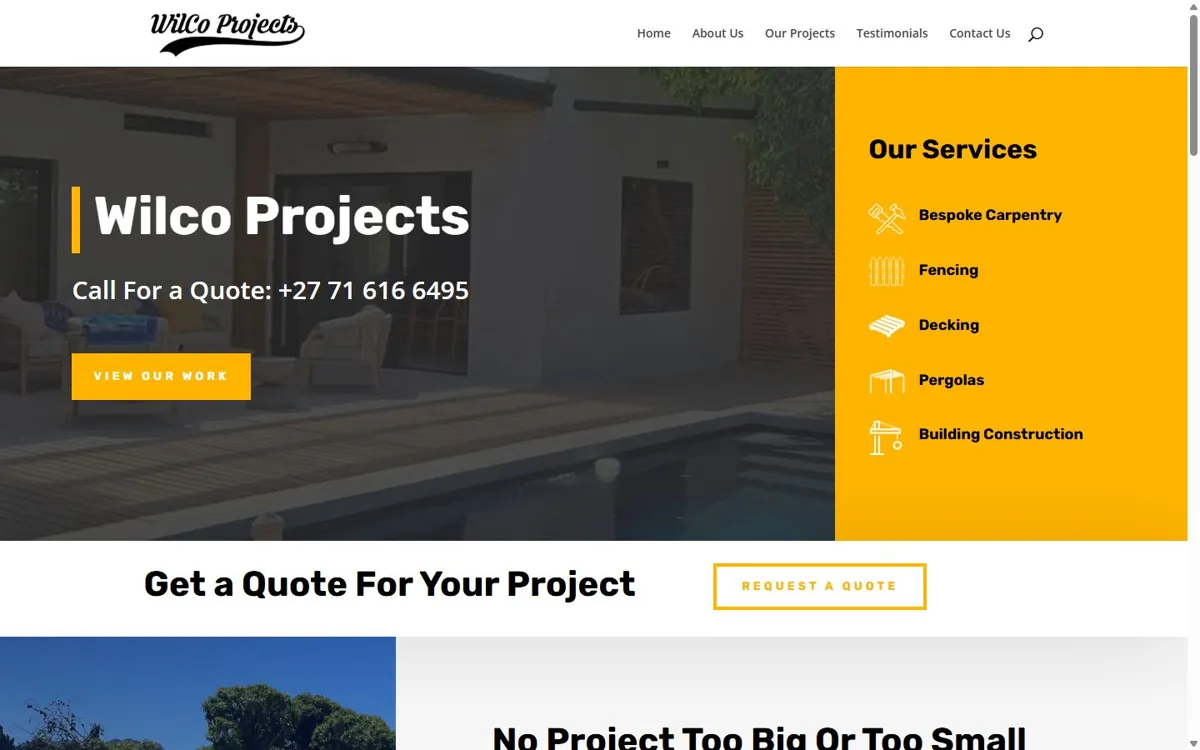
Wilco Projects provides home improvement and construction services across Cape Town, founded in November 2017 and covering neighbourhoods including the CBD, Simon’s Town, Fish Hoek, Tokai, and Capri. The business builds bespoke carpentry, timber decking, pergolas, fencing, and full kitchen and bathroom renovations, alongside general building construction work.
About Wilco Projects
Specific completed project features include custom timber slatted dividers and electric fencing integration, and the business shows six real completed project examples with photographs. Wilco Projects also references a collaboration with another contractor, Big Boss Projects, for certain work, and describes decades of combined experience across its team alongside the company’s own history since 2017.
Home improvement is a business built on visible craft. A homeowner considering a kitchen renovation or a new timber deck wants to see real, specific examples of the actual work before trusting a contractor with their own home.
What the website needed to do
With services ranging from smaller carpentry jobs to full renovations and general construction, the site needed to organise the work clearly enough that a homeowner could quickly identify whether their specific need, a new deck, a kitchen renovation, a fencing job, was something Wilco Projects actually handles, rather than presenting one undifferentiated “construction services” page.
The six real completed project examples needed genuine prominence, since specific, photographed past work is the single strongest trust signal available to a home improvement business, more persuasive than any written description of quality or care.
Why this matters for home improvement and renovation businesses generally
For any business working directly inside people’s homes, whether renovating a kitchen or building a deck, trust has to be earned before the first conversation even happens, since the homeowner is granting real access to their property based largely on what the website shows them. Real, specific project photography does more of that trust building work than polished but generic descriptions of quality workmanship.
Local area coverage also matters concretely here. Listing the actual neighbourhoods served (rather than a vague “Cape Town area” claim) helps a homeowner quickly confirm the business genuinely works where they live, and helps local search show the business to nearby searchers.
Specific project features, like a custom timber divider or an integrated electric fence, are also worth calling out by name rather than folding them into a general “carpentry and fencing” description. Naming the actual, distinctive work done gives a homeowner a much clearer sense of the kind of custom detail the business is capable of delivering.
Team experience, even when it is spread across several people rather than concentrated in one founder, is also worth stating honestly as combined years of experience, since a homeowner cares less about any one individual’s history and more about whether the team collectively has the depth of experience to handle their specific project well.
The result
Wilco Projects’s site is live now at wilcoprojects.co.za, built around the six real completed project examples, a clear service breakdown, and the specific Cape Town neighbourhoods the business serves. It is one of the businesses featured on our portfolio.
Considering something similar?
Home improvement and construction businesses vary in cost depending on how much project photography and how many services need presenting. Our Business Website package is the usual starting point. Request a quote and we can confirm exact pricing for your business.
Based in Cape Town too? Our guide to website design in Cape Town lists our local work and published prices.
For a Cape Town business in the same space that sells managed project delivery rather than individual trades, see our case study on TJ Scholtz Projects.
Frequently Asked Questions
How much does a website for a home improvement business cost?
It depends on how much project photography and how many services need presenting. Our Business Website package is the usual starting point, and we confirm exact pricing once we understand your business.
Why does project photography matter so much for home improvement businesses?
Because homeowners are granting real access to their property based largely on what the website shows. Specific, photographed examples of actual completed work build trust far more effectively than general claims about quality or experience.
Should a home improvement business list every neighbourhood it serves?
Yes, where genuinely accurate. Listing real, specific areas served helps a homeowner confirm quickly that the business actually works where they live, and it strengthens local search visibility for searches tied to those specific areas.
How should different service types (carpentry, renovations, general construction) be organised?
Clearly separated, so a homeowner with a specific need can quickly confirm whether the business actually handles it, rather than wading through one undifferentiated services list to find out.
Does a smaller, newer construction business need the same website depth as an established one?
The core needs are similar; real project photography and clear service information matter regardless of how long a business has operated. What changes over time is simply having more completed projects to show, which is worth adding to the site as the portfolio grows.
How long does a website project for a home improvement business take?
We confirm the timeline once the scope is agreed. The main variable is how much project photography is already available versus needing to be gathered before the site can properly showcase the work.
Does collaborating with other contractors need to be mentioned on the website?
Where genuinely relevant, yes. Being open about working relationships with other trusted contractors, particularly for larger or more complex jobs, signals a business that manages its projects honestly rather than overstating what it handles entirely in-house.