Sacred Mountain: A Website Case Study
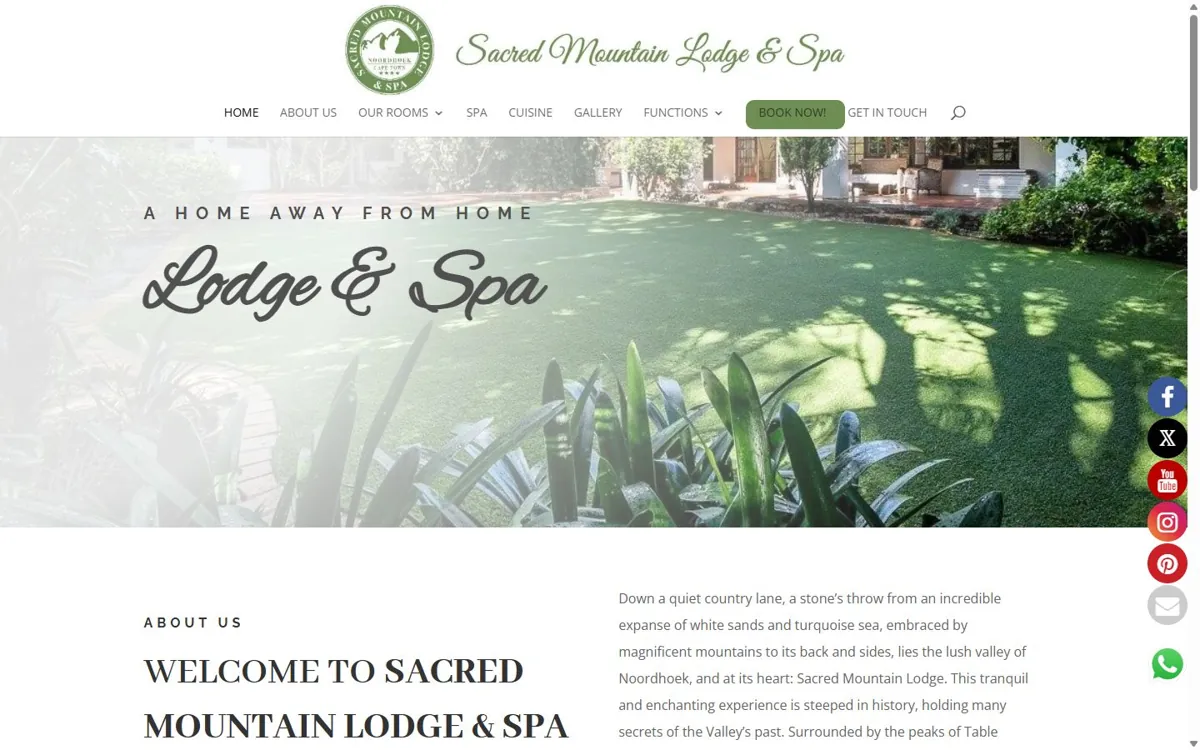
Sacred Mountain is a lodge and spa tucked down a quiet country lane in Noordhoek, Cape Town, flanked by Table Mountain National Park on one side and the ocean on the other, reached along the scenic Chapman’s Peak Drive. It is the kind of property that sells itself the moment someone sees it, which made the website’s main job clear from the start: get out of the way of the setting and let people picture themselves there.
About Sacred Mountain
Sacred Mountain offers a handful of individually named cottages, including the Owl’s Spa Cabin, the Clydesdale Suite, Vine Cottage, Squirrel Cottage, and Acorn Cottage, alongside a wellness spa with a jacuzzi and therapies, dining, and space for hosting conferences, educational retreats, and mission groups. Guests also have access to a basketball court, a put-putt course, and braai facilities on site. The property carries a 4 star rating and holds a strong Google rating from past guests.
That range of named, distinct spaces, rather than a single generic “accommodation” offering, is unusual for a lodge this size, and it shaped how the site needed to be structured.
What the website needed to do
A lodge with several individually characterful cottages, a spa, and event hosting is really running three overlapping businesses on one property: leisure accommodation, wellness, and functions. A website that flattens all of that into one page loses the detail that makes each part appealing to a different kind of visitor. Someone booking a romantic weekend in the Owl’s Spa Cabin has a different set of questions than an organiser looking to host a retreat for twenty people.
The site needed to let each cottage and each use case stand on its own, while still reading as one coherent property. That meant real photography doing the heavy lifting (a lodge like this lives or dies on whether the photos make someone want to be there), clear information about what is included at each cottage, and separate, obvious paths for a leisure booking versus a retreat or conference enquiry.
Why this matters for lodges and guest properties generally
For any accommodation business, the website carries a disproportionate amount of the sales job compared to a typical local business, because most guests are booking from somewhere else entirely, sight unseen, based only on what the site and photos show them. There is no walk-in customer who can just see the place first. Trust and desire both have to be built entirely on the page, which is why photography quality, clear cottage-by-cottage detail, and straightforward booking or enquiry paths matter more here than almost any other business type JWD builds for.
It also matters that a lodge like this competes with third-party booking platforms that take a commission on every booking. A direct website that ranks well and converts enquiries reduces reliance on those platforms over time, which is a real, ongoing cost saving rather than a one-off benefit.
Local context matters too, more than it might for a generic business. A property like Sacred Mountain benefits from telling visitors about the drive along Chapman’s Peak, the proximity to Table Mountain National Park, and what makes Noordhoek itself worth the trip, since a portion of every booking decision is really a decision about the surrounding area, not just the property alone. Ignoring that context and describing only the rooms and amenities leaves real persuasive value on the table.
For a broader look at what accommodation businesses need from a website, our guide to website design for guest houses and B&Bs covers the category in more depth.
The result
Sacred Mountain’s site is live now at sacredmountain.co.za, built on Divi with a design led entirely by the property’s own photography and its distinct, named spaces. It is one of the properties featured on our portfolio.
Considering something similar?
A multi-space property like a lodge, guest house, or venue varies in cost depending on how many distinct spaces need their own page. Our Business Website package is the usual starting point, covering up to 12 pages. Request a quote and we can confirm exact pricing for your property.
Frequently Asked Questions
How much does a website for a lodge or guest house cost?
It depends on how many distinct spaces, cottages, a spa, event facilities, need their own page. Our Business Website package is the usual starting point for a multi-space property; a smaller property with fewer distinct offerings can work well with our 3-5 page website. We confirm exact pricing once we understand your property.
Why does photography matter so much for a lodge website?
Because a guest is almost always booking from somewhere else, with no way to see the property in person first. The photos and the way the site presents each space are doing the entire job of building desire and trust that a physical visit would normally do. Weak or generic photography undersells a property no matter how good the site’s design is otherwise.
Should each cottage or room type have its own page?
If they are genuinely different (different layouts, views, amenities, or price points), yes. Bundling distinct spaces onto one generic “accommodation” page makes it harder for a guest to picture the specific space they would actually be staying in, and it gives Google less specific content to match against searches.
Does a lodge website need a direct booking system?
It depends on the property. Some lodges prefer to route enquiries through a contact or quote form and confirm manually, which keeps costs down and gives more control over unusual requests like retreats or events. Others benefit from an integrated booking calendar. We can advise on which fits your operation once we understand your booking volume and how you currently manage reservations.
How does a lodge reduce reliance on booking platform commissions?
By building direct traffic to its own website through SEO and by making the direct booking or enquiry path at least as easy as going through a third-party platform. It will not happen overnight, but a well-built, well-ranking site is the only real long-term way to reduce what a property pays away in commission on every booking.
How long does a lodge or guest house website project usually take?
Most projects like this run three to five weeks from a signed off brief to launch, with the main variable being how quickly good photography and cottage-by-cottage detail can be gathered. Properties that already have strong photography and clear information about each space move faster; properties starting from scratch usually need that groundwork done first.