ULC: A Website Case Study
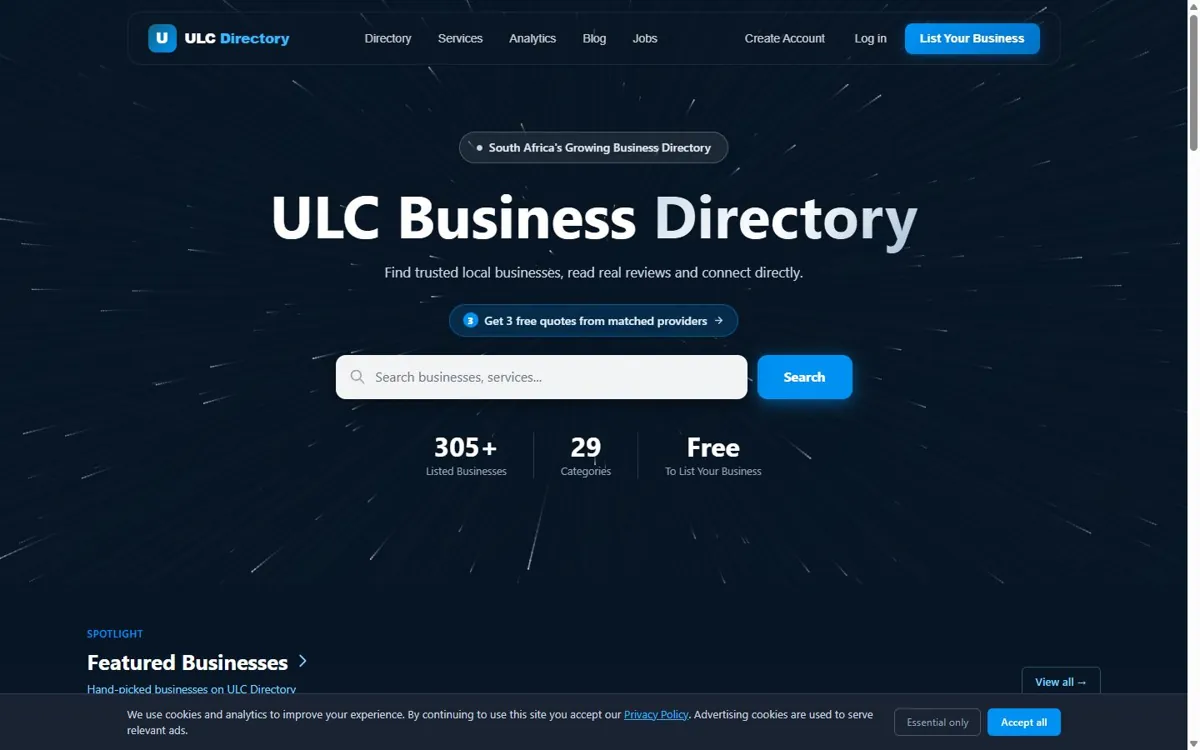
ULC is a free South African business directory, letting businesses list themselves and letting visitors browse verified local listings and reviews. The site organises businesses into 29 categories, led by Advertising and Marketing, Building and Construction, and Accounting and Finance, and breaks listings down by city, with Cape Town and Johannesburg currently the two largest.
About ULC
The directory currently carries over 300 businesses, with a curated set of featured listings on the homepage, including several other JWD client projects. Businesses can sign up for a free listing, and each is marked as verified or not, giving visitors a quick trust signal when browsing.
A directory site is fundamentally different from a typical business website. It is not selling one company’s services, it is trying to be genuinely useful as a discovery tool for two different audiences at once: businesses wanting to be found, and visitors trying to find them.
What the website needed to do
Directory sites succeed or fail on structure and search. With hundreds of listings across dozens of categories, the site needed browsing and filtering that actually works at scale, by category and by city, rather than presenting one long undifferentiated list. It also needed a straightforward, low friction path for businesses to submit their own free listing, since a directory only stays useful if new businesses keep joining it.
The verified versus unverified distinction needed to be visually clear too, since that single signal does a lot of work in helping a visitor trust a listing without having to research the business independently.
Why this matters for directory and listing platforms generally
A directory’s core technical challenge is scale. What works for twenty listings breaks down completely at three hundred, so category structure, search, and filtering are not nice to have features, they are the actual product. A directory that is hard to browse or search loses its entire value proposition regardless of how many businesses it has listed.
The two-sided nature of a directory also means the website has two genuinely different conversion goals running at once: getting visitors to find what they need, and getting businesses to sign up and list themselves. Both paths need to be clear and easy, not just one.
Featuring a curated selection of listings on the homepage, rather than only offering search, also helps a directory feel active and genuinely useful from the first visit, rather than presenting a visitor with an empty search box and no sense of what is actually available.
City-level listing counts, shown transparently, also help set honest expectations for both audiences. A visitor searching a smaller city benefits from knowing roughly how many listings to expect before browsing, and a business considering listing itself in an area with fewer competing listings may see that as a genuine reason to join early.
The result
ULC is live now at ulc.co.za, built to handle hundreds of listings across 29 categories with real category and city based browsing, a clear verified badge system, and a straightforward free listing signup path. It is one of the projects featured on our portfolio.
Underneath, ULC is a genuine multi-user Laravel web application, not a WordPress site. Businesses submit their own listings, and an admin queue lets JWD approve or reject new listings and reviews before they go live, real user roles and permissions doing real work, not a static brochure site.
Considering something similar?
Directory and listing platforms are genuinely custom projects, since they need real database driven search and filtering behind the scenes rather than a set of static pages. See our custom development work, or request a quote and we can talk through what your platform specifically needs.
Frequently Asked Questions
How much does a directory or listing website cost?
Directory sites are genuinely custom builds, since they need real search, filtering, and listing management behind the scenes rather than static pages. See our custom development work for how that is scoped and priced individually based on the platform’s actual requirements.
What makes a directory website different from a normal business site?
A directory has two distinct audiences with different goals: visitors trying to find a business, and businesses trying to list themselves and be found. Both paths need to work well, and the whole site depends on category, search, and filtering actually working at scale as listings grow.
How should a large directory organise hundreds of listings?
By category and, where relevant, by location, with real filtering rather than one long list. As a directory grows past a few dozen listings, browsability becomes the entire user experience, not a secondary feature.
Why do verified badges matter on a directory site?
Because a visitor cannot personally vet every listed business, a clear verification signal does a lot of the trust building work in a single glance, helping visitors feel confident engaging with a listing without independent research.
What keeps a directory useful over time?
A genuinely easy, low friction signup path for new businesses to list themselves. A directory that stops growing stops being useful, so removing friction from the listing process matters as much as the browsing experience itself.
How long does a directory or listing platform take to build?
Directory platforms take longer than a typical business website because of the real search, filtering, and listing management functionality running behind the scenes. A project like this usually runs several weeks longer than a standard business site, and the exact timeline depends on how the listing and category structure is scoped.
Is ULC built on WordPress?
No. ULC is a custom Laravel web application, not a WordPress site. Handling hundreds of listings with real category and city filtering, public submissions, and an admin approval queue for new listings and reviews needs genuine application logic behind it, not a theme stretched past what it was built for. It is the same kind of build we would use for any directory, marketplace, or membership platform.