WordPress.com vs WordPress.org: Which One Does Your Business Actually Need?
When you first start researching how to build a website for your business, one of the first confusing forks in the road is the WordPress.com vs WordPress.org question. They have almost identical names, they both involve WordPress, and at first glance they can seem interchangeable. But they are fundamentally different products that lead to very different outcomes for your business. At JWD Website Design, we work exclusively with one of these two options, and by the end of this guide you will understand exactly why, and which one is right for you.
The Most Important Distinction
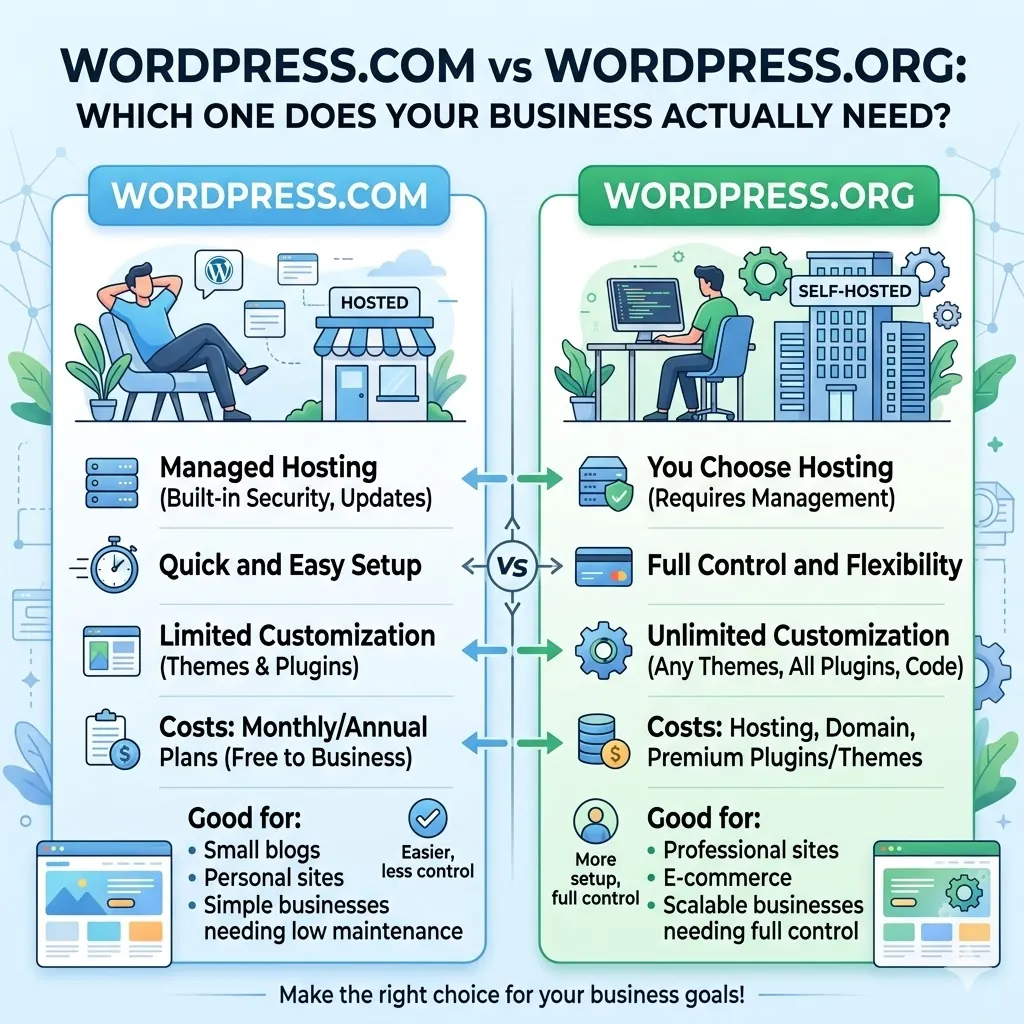
Before anything else, here is the single most important thing to understand in the WordPress.com vs WordPress.org debate: one is a hosted service and one is self-hosted software.
WordPress.org is the free, open-source software you download and install on your own web hosting. You own everything. The software is yours, the data is yours, the website is yours. There are no restrictions on what themes or plugins you can use, and you can customise your site however you like. This is the version that professional web designers, including the JWD Website Design team, use for every client project.
WordPress.com is a commercial hosting service run by Automattic, the company co-founded by WordPress’s creator Matt Mullenweg. You sign up, create an account, and your website is hosted on Automattic’s servers. There are free and paid plans available. It is easier to get started with, but it comes with significant limitations that can hold your business back.
The WordPress.com vs WordPress.org confusion happens because Automattic runs both. WordPress.com is built on the same open-source WordPress software from WordPress.org, but when it is delivered as a hosted service, the rules change considerably.
What You Can and Cannot Do
This is where the WordPress.com vs WordPress.org difference really matters for business owners.
Plugins
With WordPress.org, you can install any plugin you want. Over 60,000 are available in the free directory, plus premium options from third-party developers. This is how your website gets contact forms, SEO tools, security features, eCommerce functionality, booking systems, and everything else it needs.
With WordPress.com, plugin access depends on your plan. On the free and cheaper plans, you cannot install third-party plugins at all. You are limited to whatever Automattic has built in. For any serious business website, this is a major constraint.
Themes
With WordPress.org, you can install any theme. Premium themes like Divi, which JWD Website Design uses for client builds, are fully available. You have complete design freedom.
With WordPress.com, your theme options are limited to what Automattic approves. You cannot install a premium theme from an external developer on the basic plans.
Custom Domain
With WordPress.org, your website lives at your own domain (like yourbusiness.co.za). You register and own the domain completely, and you can pair it with affordable .co.za annual hosting or .com annual hosting that keeps everything under your control.
With WordPress.com on the free plan, your website address includes WordPress.com in it (like yourbusiness.wordpress.com). This looks unprofessional. You can pay to use a custom domain on higher plans.
Ownership and Control
This is arguably the most important point in the WordPress.com vs WordPress.org comparison. With WordPress.org, you are the complete owner of your website. Your host stores your files, but you own and can move them anywhere at any time.
With WordPress.com, your website lives on Automattic’s platform. They control the environment. In theory, they could change their terms, shut down your site, or restrict features at any time.
Cost Comparison
At first glance, WordPress.com looks like the cheaper option because it has a free plan. But the WordPress.com vs WordPress.org cost comparison is not as simple as that.
- WordPress.com costs: The free plan is very limited. Once you add a custom domain, remove their branding, and unlock basic features, the monthly costs add up. Professional and Business plans are priced in USD, which with the current exchange rate is a significant spend for South African businesses.
- WordPress.org costs: The software itself is completely free. You pay for web hosting, a domain name, and any premium themes or plugins. When you add this up, self-hosted WordPress.org is almost always the more cost-effective option for a fully functional business website.
Which is Better for SEO?
If ranking on Google is important to your business, the SEO comparison is decisive. With WordPress.org, you can install a powerful SEO plugin like Rank Math or Yoast SEO. These tools give you full control over your meta titles, meta descriptions, sitemaps, schema markup, and everything else that affects your Google rankings. JWD Website Design installs and configures Rank Math PRO on every client website we build. You can read more in our guide to WordPress on-page SEO, and if your existing site has stalled, our SEO Rescue and monthly SEO maintenance services can get it back on track.
With WordPress.com, SEO tools are built in but very basic, especially on lower plans. For South African businesses investing in SEO, WordPress.org is the clear winner. Read our overview of SEO for small businesses to understand why this matters.
eCommerce
If you plan to sell anything online, the eCommerce comparison is easy. With WordPress.org, you install WooCommerce (free) and you have one of the world’s most powerful eCommerce platforms. You can accept payments through Yoco, PayFast, or any other South African payment gateway. JWD Website Design builds WooCommerce stores regularly through our e-commerce website packages. Read our guide to WooCommerce website design to see what is possible.
When Might WordPress.com Make Sense?
To be completely fair in the WordPress.com vs WordPress.org comparison, there are scenarios where WordPress.com is reasonable:
- A personal blog with no commercial intent
- A hobby site that does not need advanced features
- Someone testing WordPress for the very first time
- A very short-term landing page
For any serious business website, however, the answer is consistently WordPress.org.
The Decision for South African Businesses
At JWD Website Design, every single website we build uses WordPress.org on self-hosted servers. When our clients ask about the WordPress.com vs WordPress.org choice, our answer is always the same: for a professional business website that you own, can grow, and can properly optimise for search engines, WordPress.org is the only sensible choice.
Explore our business website builds for South African businesses or look at our smaller 3-5 page website packages to find the right starting point for your project. Follow us on Facebook to see examples of our work.
Summary
| Feature | WordPress.com | WordPress.org |
|---|---|---|
| Cost | Free to expensive | Free software, pay hosting |
| Plugins | Restricted | Full access |
| Themes | Limited | Full access |
| Custom domain | Paid plans only | Yes, full ownership |
| eCommerce | Limited | Full WooCommerce |
| SEO control | Basic | Full control |
| Ownership | Automattic’s servers | Yours completely |
| Advertising | Their ads on free plan | You decide |
The WordPress.com vs WordPress.org debate ends the same way every time for serious business websites. WordPress.org gives you ownership, flexibility, and power. WordPress.com gives you convenience at the cost of control. If you are building a business website in South Africa and you want it to work hard for you, WordPress.org is where you start.
Ready to launch a WordPress.org site you actually own? Request a free quote or browse all our website design and hosting packages and JWD Website Design will make the process simple from day one.
Frequently Asked Questions
What is the difference between WordPress.com and WordPress.org?
WordPress.org is free, open-source software you install on your own web hosting, so you own the software, data, and website completely. WordPress.com is a commercial hosting service run by Automattic, where your site lives on their servers. Both use the same WordPress software, but WordPress.com adds restrictions once it is delivered as a hosted service.
Can I install any plugin or theme on WordPress.com?
Not on the free and cheaper plans. With WordPress.com you cannot install third-party plugins at all on those plans, and your theme options are limited to what Automattic approves. With WordPress.org you can install any of the 60,000-plus free plugins, premium plugins, and any theme, including premium themes like Divi that JWD Website Design uses for client builds.
Which is better for SEO, WordPress.com or WordPress.org?
WordPress.org is the clear winner. It lets you install a powerful SEO plugin like Rank Math or Yoast SEO, giving full control over meta titles, descriptions, sitemaps, and schema markup. JWD installs and configures Rank Math PRO on every client site. WordPress.com SEO tools are built in but very basic, especially on lower plans.
Can I run an online store on WordPress.org?
Yes. With WordPress.org you install WooCommerce, which is free, giving you one of the world’s most powerful eCommerce platforms. You can accept payments through Yoco, PayFast, or other South African payment gateways. JWD Website Design builds WooCommerce stores through its e-commerce website packages, priced at R6500.
Which option does JWD recommend for a South African business website?
WordPress.org. Every single website JWD Website Design builds uses WordPress.org on self-hosted servers, because it gives you a site you own, can grow, and can properly optimise for search engines. You can start with a 3-5 page website at R3500 or a Business Website at R6000, paired with affordable local hosting.