Soma Laser: A Website Case Study
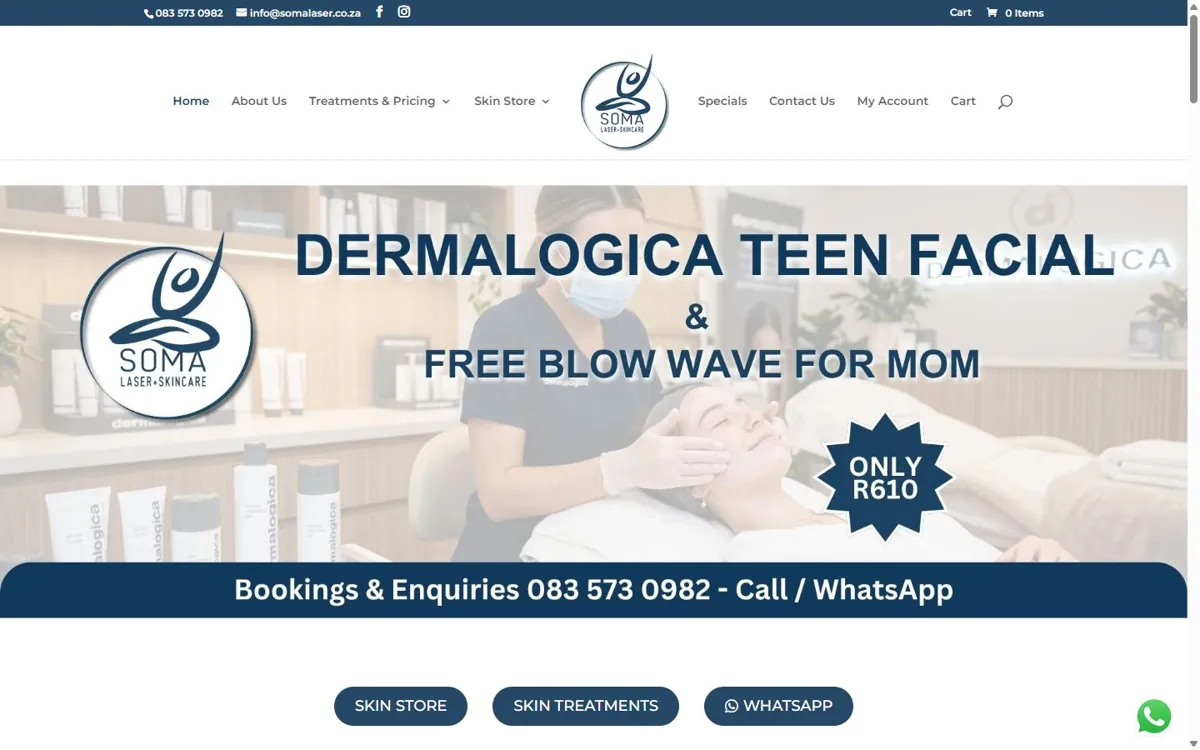
Soma Laser is a skincare and laser clinic in Pretoria, established in 2009, offering what it describes as affordable, medical grade skincare and anti-aging treatments for all skin types. The clinic runs five treatment rooms and three nail stations, and sells skincare online through its own skin store.
The old site ran on WordPress, a page builder and WooCommerce. In October 2026 we replaced it with a custom application built on Laravel, and the new site went live on 12 October 2026. The design was kept deliberately close to the old one, so returning clients still recognise it. What changed is everything underneath it, and the biggest change is speed.
Why rebuild instead of keep optimising
We had already spent months tuning the old site, and some of that work helped. The trouble was consistency. With a warm cache the old site could test well, but a visitor arriving after the cache had cleared waited for the whole platform to build the page from scratch, and the page itself was heavy.
On 28 September 2026, Google’s PageSpeed Insights mobile test scored the old home page 39. The largest element took 12.1 seconds to appear, the page downloaded almost 3 MB, and it loaded 19 stylesheets that each held up the first paint, one of them 824 KB on its own. Google’s real visitor data for the same page failed its Core Web Vitals assessment, with the main content taking 7.2 seconds to show.
At that point more tuning was treating symptoms. A page builder, a theme and a stack of plugins all add their weight to every page whether that page uses them or not. Our guide on why a WordPress website is slow covers how that accumulates.
Speed, measured on the live site
Measured with Google PageSpeed Insights, the same test before and after:
| Old site, mobile (28 Sep 2026) | New site, mobile (13 Oct 2026) | New site, desktop (13 Oct 2026) | |
|---|---|---|---|
| Performance | 39 | 93 | 98 |
| Largest Contentful Paint | 12.1 s | 2.7 s | 0.8 s |
| Total Blocking Time | 90 ms | 0 ms | 0 ms |
| Cumulative Layout Shift | 0.424 | 0 | 0.004 |
| Stylesheets on the home page | 19 | 1 | 1 |
The new site also scores 97 for Accessibility, 100 for Best Practices and 100 for SEO on both mobile and desktop, and passes all four of Google’s new Agentic Browsing checks.
Lab scores move a few points between runs, so read them as a range rather than an exact number. Google’s real visitor data is averaged over 28 days, so it will show the new site properly from mid November 2026.
Most of the gain came from subtraction. There is no page builder and no theme to load, so the whole site uses one stylesheet. Images are served at the size the screen needs: on a phone, the home page slider now downloads about 105 KB instead of 489 KB. Layout shift is zero because the space for every image is reserved before it arrives.
Same look, rebuilt underneath
A clinic’s regular clients book from the site, and a redesign they do not recognise costs trust it does not need to. So the layout, colours and navigation stay familiar: Treatments and Pricing, the Skin Store, Specials, and the booking and WhatsApp buttons are where people expect them.
The treatment menu is long, from laser hair removal on an Elysion-Pro Diode medical laser, Dermalogica facials and Lamelle peels through to fat freezing, micro-needling, tattoo removal, nails and the Blow Wave Bar. It is still organised around the clinic’s real treatment categories, so someone searching for one specific treatment lands on content about that treatment.
What the site does now
The rebuild was also the chance to add what the clinic needed and the old setup made awkward.
- A proper skin store. Delivery priced by zone, discount codes, and an invoice with unbroken numbering for every order.
- Gift cards. An open-value voucher from R100 to R5,000 and fixed treatment vouchers. A card is only issued once its order is paid, a partly used card keeps its balance, and clients can check what is left on a balance page.
- Payflex, rebuilt. Clients can still pay in instalments, and the site now hears from Payflex directly when a payment completes, rather than relying on the customer’s browser making it back.
- Customer accounts that carried over. Existing customers were moved across and log in with the password they already had. They can see their orders and invoices, and reorder in one step.
- Search that suggests as you type, and answers to common questions on product pages.
- An admin built for the clinic. The team manages products, orders, enquiries, gift cards, invoices, pages and articles in one place. The dashboard shows sales month on month and orders that are paid but not yet sent, stock and prices can be changed in bulk, and updating an order’s status can email the customer in the same step.
- A cookie notice that does what it says. Analytics and advertising tags wait for consent instead of loading first.
Search engines and AI answer engines
A rebuild only helps if Google, Bing and AI assistants can still find everything, so search was part of the build rather than an afterthought.
- Nothing was lost in the move. We tested all 466 live addresses from the old site against the new one. Every one lands on a real page, in a single redirect where the address changed, and the top ranking pages were checked again after launch.
- Structured data tells search engines and AI answer engines what each page is: the clinic as a medical business with its address and hours, treatments as services, products with their prices, articles, frequently asked questions and breadcrumbs.
- Clean basics on every page. One clear main heading, a unique title and description, and alt text on every image.
- Built for AI assistants. An llms.txt file and a machine readable catalogue of the clinic’s products give assistants like ChatGPT a clean summary to work from, and the robots file names the AI crawlers that are welcome.
- Indexed quickly. All 325 pages in the new sitemap were submitted through IndexNow after launch.
Our guide to AI search optimisation for South African businesses explains why this matters for a local clinic.
Security
Moving off WordPress removed its whole plugin layer, and that is where most of the risk sits: Patchstack’s State of WordPress Security in 2026 report found that 91% of the new WordPress vulnerabilities reported in 2025 were in plugins. On top of that:
- Security headers on every page, including HTTPS enforcement, protection against the site being framed by another site, and a content security policy that limits where scripts can load from.
- Bot protection on sign in, registration, checkout, the contact form, password resets and order lookups.
- Rate limits on gift card balance checks, discount codes and order lookups, so they cannot be guessed at speed.
- The admin is limited to staff. A shop account cannot be turned into an admin account.
- Stronger password storage. Migrated passwords are upgraded to modern hashing the first time each customer signs in.
- Encrypted email sending, and a full backup taken and test restored before the switch, with the old site kept aside in case it was ever needed.
The build carries more than 270 automated tests, concentrated on the places where a silent failure costs money or trust: checkout, payments, gift cards and accounts.
The result
Soma Laser’s site is live at somalaser.co.za, looking much as clients remember it but loading in a fraction of the time, with a real skin store, gift cards, Payflex, customer accounts and an admin built around how the clinic works. It is one of the businesses featured on our portfolio, and the same approach is behind our iOrganic rebuild.
Considering something similar?
If your site looks right but loads slowly, a rebuild that keeps the design can be the least disruptive fix. Our guide to custom website development in South Africa sets out when a custom build is the right answer and when it is not, and our custom CMS e-commerce package is the usual starting point for a clinic with a shop. For clinics specifically, see our guide to website design for medical aesthetics clinics. Request a quote and we can scope the work around your treatments and products.
Frequently Asked Questions
Why rebuild a website instead of optimising the one I have?
Optimise first if the slowness comes from one heavy page or a few large images. Rebuild when the weight comes from the platform itself: a page builder, a theme and many plugins that load on every page. Here the old site could score well with a warm cache, but cold visits and real visitor data stayed poor, which is a sign the problem is underneath the pages rather than on them.
Can you rebuild my website without changing how it looks?
Yes. Soma Laser’s new site keeps the familiar layout, colours and navigation, so returning clients find things where they expect them. Keeping the design is often the safest choice for a business whose clients already book through the site.
Will I lose my Google rankings if I rebuild my website?
Not if every old address is accounted for. On this project we tested all 466 live addresses against the new site before the switch, redirected the ones that moved in a single step, and checked the top ranking pages again after launch.
Will my existing customers have to create new accounts?
Not necessarily. Soma Laser’s existing customers were moved across with their accounts and can sign in with the password they already had, which is upgraded to modern hashing on their first sign in.
Why does page speed matter for a clinic website?
Many people look for a clinic on their phone, often on mobile data. A page that takes several seconds to show anything loses them before they see a treatment or a price. Core Web Vitals are also among the page experience signals Google’s ranking systems consider, although good scores do not guarantee rankings on their own.
Is registration required for laser and skincare treatments?
It depends on the treatment. Invasive or injectable procedures legally require HPCSA or SANC registration in South Africa. Non-invasive treatments like facials, laser hair removal and microdermabrasion do not carry the same requirement, but a clinic offering both should be clear on its site about which is which.
Should payment options like Payflex be shown on the site?
Yes, especially for clinics where a course of treatments or a skincare order is a meaningful spend. Showing a pay later option upfront, rather than only at checkout, reduces hesitation for someone who is interested but weighing up the cost.
What does a website rebuild like this cost?
It depends on the size of the treatment menu, the shop, and how much of the admin needs building. Our custom CMS e-commerce package is the starting point, and a larger build is quoted on scope once we understand the clinic.